Simultaneous vs Consecutive Interpretation: Which Do Churches and Events Need?
The planning meeting usually stops at “we need an interpreter.” That is not a complete decision. Consecutive interpretation asks the speaker to pause so a second voice can take the room. Simultaneous interpretation lets the speaker keep going while someone else renders the meaning a few seconds behind. The length of the hour, who hears what, and whether a guest needs a headset all change with that choice.
This is a comparison of those modes—not a setup tutorial, and not a verdict that software should replace every human interpreter. If you are already deciding who should do the work, start with live translation vs a human interpreter. The question here is the shape of the hour.
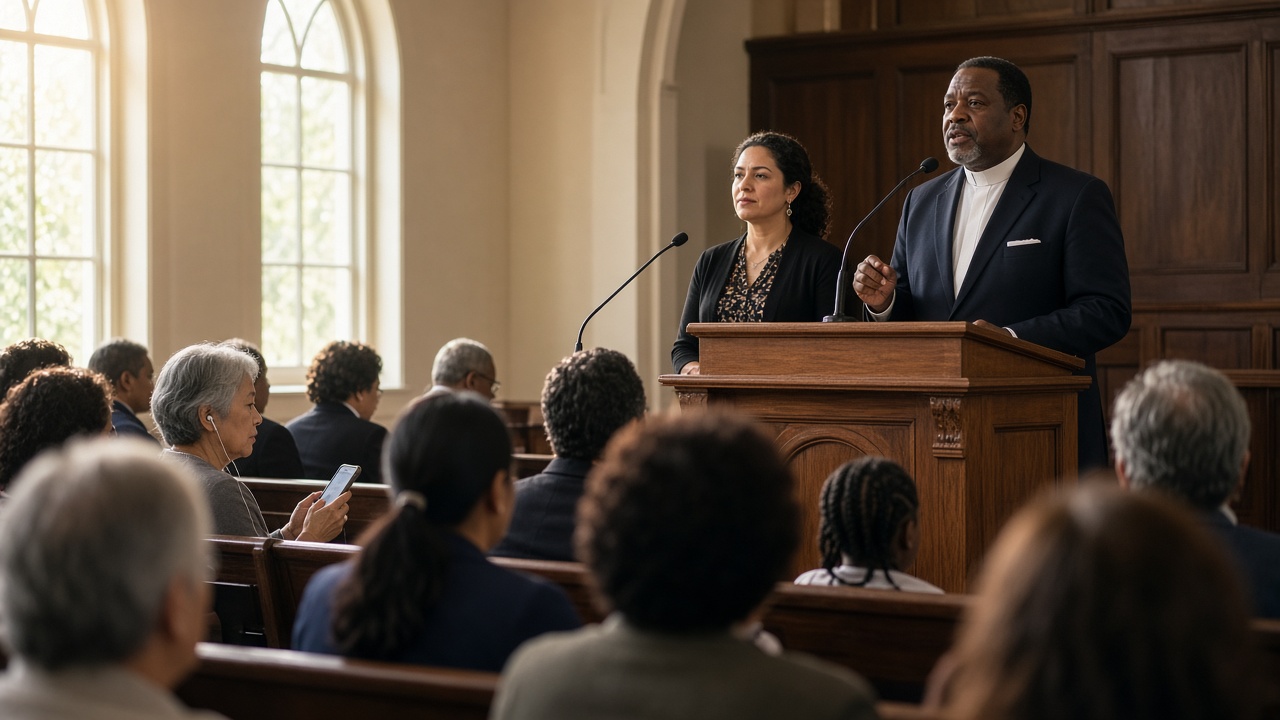
Translation is written. Interpretation is spoken.
People say “translation” for almost every language job. Professionals split the work.
Translation is for text you can revise: a bulletin, a slide deck, a website, a sermon manuscript sent on Thursday. The translator has time to check a name, a verse, or a product term.
Interpretation is for speech as it happens: a sermon, a keynote, a Q&A, a hallway conversation. There is no second draft for the people sitting in the room.
Live captions sit in between: written, but chasing a voice. They are still not a second speaker on the platform. A bilingual bulletin does not make Grandma follow the preaching.
The rest of this article is about interpretation modes. Written translation is a different purchase.
Consecutive interpretation: the speaker waits
In consecutive interpretation, the speaker and the interpreter take turns. The preacher or keynote finishes a sentence or a short stretch, then stops. The interpreter delivers that meaning in the other language, usually into the same public-address system. Then the speaker starts again.
The American Translators Association describes this as interpreting after the speaker has finished a segment. The European Commission’s interpreters use the same split: consecutive after the speaker; simultaneous during the speech.
Churches meet this mode on the platform: a bilingual member beside the pastor with a second microphone. The room hears both languages. No one has to scan a code. Event teams meet it at a dinner speech, a press Q&A, or a short welcome where the schedule can stretch.
What consecutive does well is unity of attention. If most of the room needs the second language, putting it on the house speakers is hospitality, not a special channel. It also works when you do not want devices in the room.
What it costs is time. Every idea is spoken twice, so the hour roughly doubles. A 35-minute sermon becomes something closer to 70. A 20-minute keynote slot does not survive that math. Jokes, stories, and altar calls are built for one voice, not for a pause after every paragraph. Consecutive usually covers one target language well. Adding Korean next to Spanish is another turn, or another hour.
Use consecutive when the pause is part of the design: a bilingual new-member class, a funeral where the family wants both voices from the pulpit, a 10-minute greeting. Do not use it as the default for a timed Sunday or a packed conference agenda unless you have already decided the extra hour is the ministry.
Simultaneous interpretation: the speaker continues
In simultaneous interpretation, the speaker does not wait. The interpreter holds a short stretch of meaning and speaks in the other language while the original continues. Interpreters call the gap the ear–voice span. A few seconds of lag is normal; instant word-by-word output would copy the source grammar and miss the point. AI live translation lives with the same constraint; see why live translation has a delay.
Conference simultaneous work usually happens in a booth. Listeners wear receivers. The European Commission lists this as the standard conference mode. The International Association of Conference Interpreters (AIIC) treats the concentration as intense enough that interpreters typically work in pairs and take turns about every 20 to 30 minutes.
Churches often skip the booth and still attempt the mode: a volunteer in a side chair, whispering or speaking into an FM transmitter, covering the whole service alone. That is simultaneous work without simultaneous staffing. Volunteer interpreter burnout is what that design produces.
What simultaneous does well is protect the original runtime. People who already follow the floor language never sit through a second voice. People who need another language receive it as a private channel.
What it costs is infrastructure and isolation. Someone has to interpret for the entire hour. Listeners have to hold a receiver, a rented headset, or a phone. How that hardware is handed out is a separate choice; see church translation equipment vs phones. The second language is hidden. That is a feature in a mixed room, and a drawback if you wanted both voices as one public service.
Use simultaneous when the speaker cannot pause, when only part of the room needs another language, or when you need more than one target language without stacking consecutive turns.
Whisper interpreting: simultaneous without a booth
Whispered interpretation—often called chuchotage—is simultaneous work without a booth. The interpreter sits beside one or two people and whispers into an ear. The European Commission lists it as its own mode. Professional guidance is blunt: it is for a very small number of listeners, it creates a murmur, and it is exhausting because the interpreter is competing with the house sound.
Churches do this without naming it. A teenager whispers the sermon for a visiting grandmother. A greeter slides into the pew of a first-time family. It feels like hospitality. It is also a second job that isolates the guest and spends the volunteer. Events use a cleaner version for a VIP. It still does not scale to a row, a breakout, or a sanctuary.
Treat whispering as an emergency overlay for one or two people, not as the language plan. If a family needs another language every Sunday, whispering is a symptom that the public hour has no access system.
Where AI live translation sits
AI live translation is not consecutive. It does not take the microphone. The pastor or keynote keeps the original pace. It is also not a booth: there is no second human voice that you staff per language. The host captures the speaker once. The system transcribes that speech and translates it while the talk continues. Listeners read the other language, hear an AI voice, or both.
That is simultaneous-style delivery: the floor language does not pause, and people who need another language follow on a private channel. It is not the same as a trained conference interpreter. A human still carries tone, theology, humor, and the conversations that should never have been added to a caption feed. Counseling, membership interviews, and legally sensitive meetings still need a qualified person.
Hope Translator is built for the overlay job: live transcription and translation on the web and in the mobile apps, with broadcast (one speaker → many listeners) and solo / conversation (one-to-one) modes. Attendees join with a QR code or link and do not create an account. They pick a language. One session can serve more than one output language without a second consecutive turn.
That is the right tool when the hour you already run should stay the hour you already run—Sunday, a conference agenda, a mixed congregation, a guest who walked in without an interpreter on the roster. It is the wrong tool when two public languages from the same pulpit are the point, or when a missed nuance is pastoral or legal.
Side by side
Use this in the planning meeting when someone says “interpreter” and means four different rooms.
| Decision | Consecutive | Simultaneous (human) | Whisper | AI live translation | | --- | --- | --- | --- | --- | | Does the speaker pause? | Yes | No | No | No | | Length of the hour | Roughly doubles | Original runtime | Original runtime | Original runtime | | Who hears the second language | The whole room, on the PA | People with receivers or headsets | One or two people next to the interpreter | People who open a link or scan a code | | Typical languages | One, well | One per interpreter team | One | Listeners pick from the session | | Staffing | One interpreter on the platform | Often a pair per language, rotating | One person glued to a guest | A host on the speaker feed | | Best first fit | Most of the room needs the other language; the schedule can stretch | Timed hour; mixed room; conference booths | One unexpected guest, once | Timed hour; several languages; visitors; no booth |
This is not a scorecard where one column should win every row. It is a map of what you are actually buying.
How to choose for this room
Ask the room four questions before you book a person or a platform.
Can the speaker pause without breaking the event? If the answer is no—Sunday at 11:00, a 20-minute keynote, a livestream that cannot run long—consecutive is already the wrong mode. Simultaneous-style delivery (human booth or AI overlay) is the honest fit.
Does most of the room need the second language, or only some people? If most people need it, consecutive on the house speakers can be the more dignified choice. If most people already follow the floor language, do not make them sit through a doubled hour so a few guests can follow. Give those guests a channel.
How many target languages? Consecutive stacks poorly. Simultaneous humans stack by hiring. An overlay stacks by letting listeners pick. If you are guessing at the door which language will walk in, a mode that requires a named interpreter for each language will fail the guest you did not schedule.
Is a human voice on the platform part of the ministry? Sometimes yes. A bilingual funeral, a visiting preacher working sentence by sentence, a class meant to be two languages in public—those are consecutive on purpose. Do not replace that with a phone because phones exist. Do not keep it for the main Sunday hour only because it is the method you already know.
Picture a few rooms as examples, not as customer stories. A mixed-language Sunday that cannot add 30 minutes wants simultaneous-style: a human booth if you have the people, an overlay if the public hour should not depend on one volunteer. A new-member class designed so English and Spanish speakers learn together can use consecutive, if you planned the extra time. A conference keynote with several languages wants simultaneous; a booth team for one high-stakes floor language is still common, and an overlay covers the languages you will not staff. One visiting family this week is what churches whisper for; a QR card at the welcome table is the same kindness without spending a teenager’s Sunday.
If the deeper issue is whether this English hour should carry other languages at all, that is a different article: Spanish service vs live translation. Mode is what you choose after you decide the hour should be followable.
Pick the mode before you book the person
“We need an interpreter” produces whatever the bilingual volunteer already knows how to do. Name the mode first. Consecutive, simultaneous, whisper, or an overlay are different purchases. They create different Sundays and different conferences.
If the speaker must keep going, and the people who need another language should not have to announce themselves as a problem, simultaneous-style access is the job. Hope Translator can run that overlay from a laptop or a phone so the original hour stays the original hour. Compare current plans on pricing, or start a session at hopetranslator.com and test it on a talk you already give.