Why Live Translation Has a Delay
You start a Sunday demo. The pastor is already on the next sentence when the Spanish caption appears. The first instinct is that the Wi-Fi failed, or that the tool is broken. Usually it is neither. A short lag is how live speech translation protects meaning. Instant word-by-word output would be faster—and worse.
This is not a setup tutorial. It is the evaluation question pastors, church tech teams, and event organizers hit the first time they try a live translator: if it is “real time,” why is it not now?
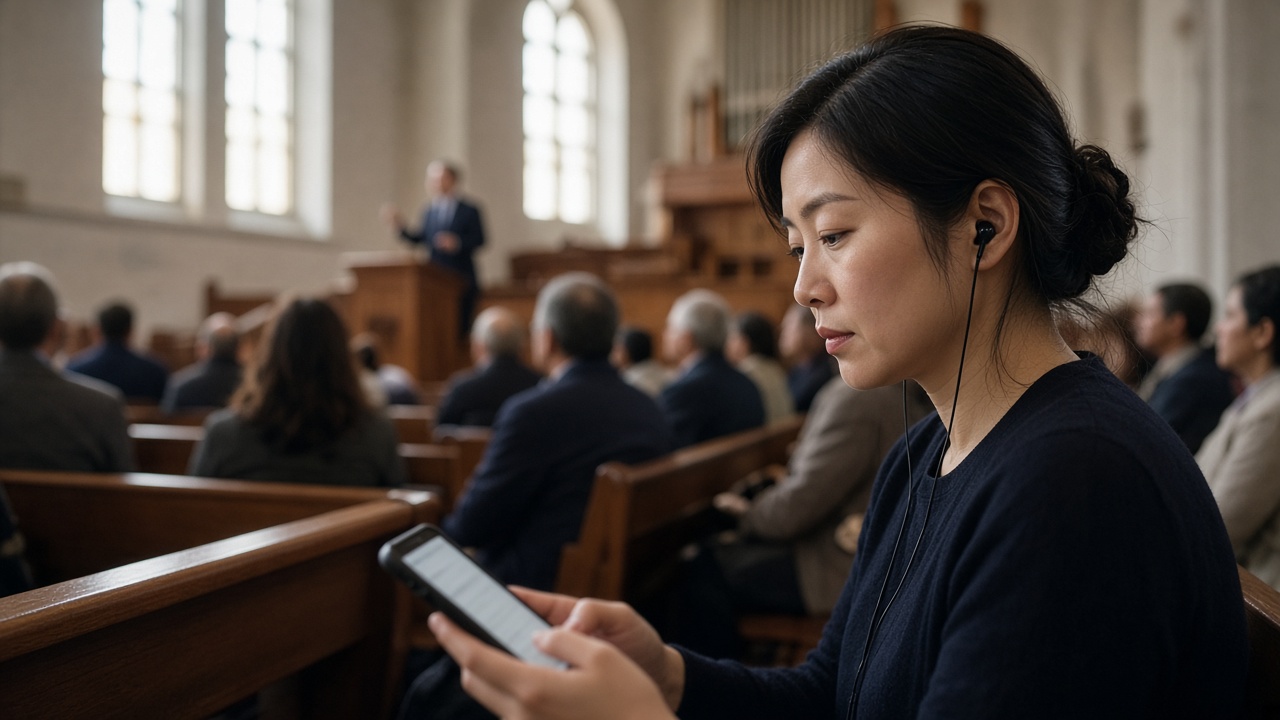
The delay is not a bug. It is a wait for meaning.
Languages do not line up word for word. A sentence can change its job in the last clause. “I am not asking you to leave this church—I am asking you to invite someone back” is a different message from the first half alone. A system that prints the first eight words the instant it hears them will mislead the listener, then have to rewrite the line.
Human simultaneous interpreters live with the same constraint. They do not start speaking the moment a word arrives. They hold a short stretch of speech, decide what it means, and then speak. Interpreters call that gap the ear–voice span. Published interpreting research and professional associations describe it as a few seconds on purpose—not as slowness, and not as a connection problem. Wait too little, and you copy the source grammar. Wait too long, and you fall behind the next idea.
AI live translation faces the same trade-off. It can emit sooner with less context, or wait for a more complete phrase. That choice cannot be removed. It can only be tuned. For what “accurate enough” means once the words do arrive, see How Accurate Is AI Live Translation in 2026?.
Live translation is a pipeline, not a single instant
Most live speech systems do not hear a language and instantly speak another. They work in stages:
- Speech recognition turns audio into text in the speaker’s language.
- Machine translation turns that text into the listener’s language.
- Optional text-to-speech reads the translation aloud.
Each stage needs a chunk of speech, not a single phoneme. If recognition is still guessing the last word, translation cannot be sure. If translation is still waiting on a verb, the voice cannot start. The pipeline is why a clean microphone helps more than a “faster” phone: garbage in the first stage becomes delay and error in the next.
Network delivery adds a little more time. So does generating speech. Those are usually the smaller parts. The larger part is the wait for a phrase that is safe to commit.
Captions can revise. A spoken line cannot.
Reading and listening do not feel the same, even when they come from the same session.
Captions can appear, then settle. Early words are a hypothesis. When the rest of the sentence arrives, the line can be corrected. That flicker is not a glitch. It is the system declining to lock a meaning it does not have yet.
Spoken translation cannot unsay a sentence. Once a voice has read a phrase into someone’s ear, a rewrite is too late. Listening paths therefore tend to wait for a more stable stretch than caption paths. That is why the audio often feels a beat later than the text on the same phone. It is also why a short delay is easier to live with in one earbud than when you try to read a screen and hear the room at the same time.
Hope Translator hosts can lean this trade-off with the Sentence length setting in the hosting broadcasts manual: shorter phrases arrive faster; more complete phrases wait for a fuller sentence. Faster is not automatically better. A jittery half-thought is harder to follow than a line that lands a moment later and makes sense.
When a few seconds is fine—and when it is not
Delay is not one experience. It depends on what the room is doing.
A sermon, keynote, or lecture is the easy case. The listener is receiving, not negotiating turns. A short lag is closer to sitting a few rows back than to missing the talk. Reviewers of Hope Translator describe that lag as expected in any simultaneous work, and treat headphones as the thing that makes it fade—see Hope Translator Reviews.
A laugh, an amen, or a room-wide reaction is the awkward case. The platform joke lands, the pews laugh, and the translated line arrives a breath later. One earbud keeps you in the room and in the translation. Two sealed earbuds turn the lag into a second room. That is a listening choice, not a reason to reject the tool. For what to wear, see best earbuds for live event translation.
Q&A, panels, and hallway conversations are the hard case. Turns are short. A delay that is invisible in a 35-minute message is obvious when two people are handing a microphone back and forth. Overlapping speech makes it worse: recognition cannot finish a sentence that two mouths are writing at once. For those hours, a human interpreter or a slower consecutive rhythm is sometimes the better design—not because AI “failed,” but because the job is turn-taking, not one long talk.
Legal, medical, and other certified settings are a different standard altogether. Delay is not the issue. Exact wording is. Do not use live AI translation as a substitute there.
What actually shrinks delay—and what does not
Hosts often try to buy their way to “zero latency.” That purchase usually misses the cause.
Clean speech-only audio helps. A mixer feed or a lav close to the mouth gives recognition a finished word sooner. A phone on the back pew, a piano under the voice, or two people sharing a handheld mic makes the first stage hesitate. Hesitation feels like lag.
A stable connection helps a little. Weak guest Wi-Fi makes the delivery stutter. It does not remove the wait for meaning. Fix the host feed first; then check that listeners are not on a congested guest network.
Headphones help more than people expect. The translation is not late relative to itself. It is late relative to the house speakers. Cover one ear, and the comparison stops shouting.
Bluetooth is a small extra, not the main delay. Typical wireless earbuds add a fraction of a second on top of a multi-second translation pipeline. Gaming “low-latency” buds will not make a sermon feel simultaneous. Spend that money on the host microphone.
“Instant” marketing is the wrong test. Any system that translates while someone is still talking has to guess or wait. Human booths guess and wait too. If a vendor promises zero delay and perfect sentences, they are selling a different job—or they are not describing live speech.
How to judge a demo without treating lag as a fail
Sit where a guest would sit. Use one earbud. Play a real sermon or conference talk, not a marketing clip.
Ask better questions than “is it instant?”
- Can I follow the point of each paragraph?
- Do names, Scripture references, and numbers survive?
- Does the spoken voice stay listenable for twenty minutes, or do I keep dropping out to check the room?
- When the speaker tells a story with a turn at the end, does the translation wait long enough to get the turn right?
If the transcript in the speaker’s own language is already wrong, the delay is not the problem. Fix the mic. If the transcript is clean and the other language is one thought behind, you are seeing simultaneous work behave like simultaneous work.
For a Sunday, that is usually enough. Guests did not come to audit milliseconds. They came to understand the hour.
Where Hope Translator fits
Hope Translator is built for live transcription and translation of speech—on the web and in the mobile apps—with broadcast (one speaker, many listeners) and solo / conversation (one-to-one) modes. Listeners join with a QR code or link, pick a language, and read captions or listen to an AI voice. They do not create an account.
It will not make a sermon simultaneous in the sci-fi sense. No honest live translator will. What it can do is put a followable second language in the pew without asking the same bilingual volunteer to work a second shift, and without a bin of receivers. Hosts who want a faster caption can shorten sentence length. Hosts who want a more complete line can wait a moment longer.
If you are weighing that delay against hiring a person for the hour, remember that a human interpreter is also a few seconds behind—and can only cover one language at a time. The useful comparison is live translation versus a human interpreter for the job you actually have, not a fantasy of zero lag.
Ready to hear the delay in a real talk instead of imagining it? Start a demo at hopetranslator.com, put in one earbud, and decide whether you can follow the message. That is the test that matters.