Spanish Service vs Live Translation: How Churches Decide
A family visits on Sunday. The dad follows the English sermon. Mom and grandmother do not. After the service, three options land on the elders’ table: start a Spanish service, ask a bilingual member to interpret from the platform, or add live translation to the service you already have.
Those are not the same ministry. One builds a congregation that prays, sings, and is shepherded in Spanish. One slows the English hour so two languages can share a room. One lets mixed-language households stay together while visitors pick a language on their phone. This guide is the decision—not a setup tutorial.
The same framework applies if the language in your community is Korean, Mandarin, Vietnamese, Arabic, or Portuguese. Spanish is the most common U.S. case, so it is the example throughout.
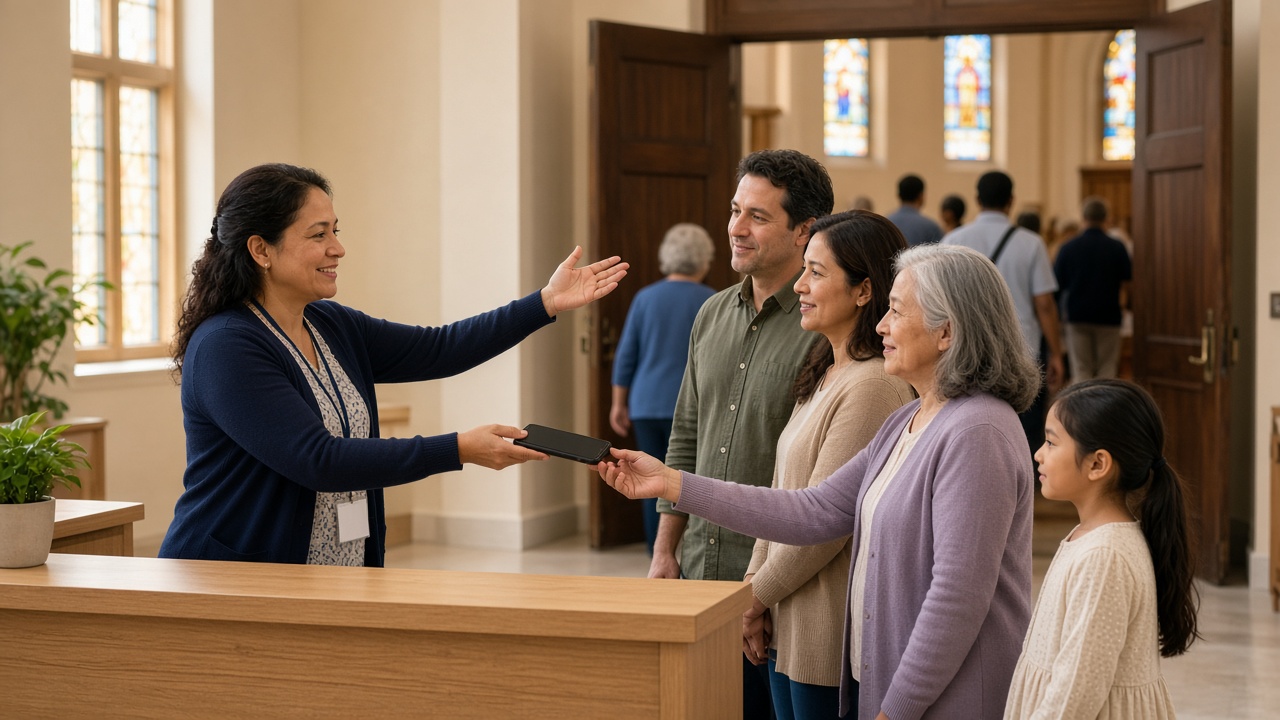
The three models churches actually choose
Most English-speaking churches land in one of three patterns. Naming them clearly stops a useful conversation from collapsing into “we should do something about Spanish.”
Live translation overlay. The pastor still preaches in English. Listeners follow on their own phones—or on a shared screen—in another language, as captions, audio, or both. One audio source reaches many listeners. This is the broadcast pattern used for live sermon translation: a QR code or link, no attendee account, each person choosing a language.
Platform interpretation. A bilingual person stands beside the preacher and interprets sentence by sentence, or a consecutive interpreter works from a headset booth. The room hears two voices. The service gets longer. You usually cover one target language well, and you depend on that interpreter showing up every week.
A second-language service. You launch a Spanish hour (or campus) with Spanish-speaking leadership, worship, preaching, and pastoral care. Translation is no longer the strategy. Belonging in Spanish is.
None of these is a consolation prize. They solve different problems.
What each model is good at
Live translation is strong when the household is mixed. A teenager who thinks in English can sit with a parent who thinks in Spanish. A visitor does not have to choose the “Spanish door” or the “English door” on the first Sunday. You can cover more than one language in the same hour—Spanish plus Korean plus Vietnamese—without hiring a second interpreter for each. Setup is a clean audio feed, a host session, and a way to share the session with a QR code.
Platform interpretation is strong when the church wants a human voice in the room and can staff it. A skilled interpreter carries tone, humor, and theological weight in ways a machine still approximates. The tradeoff is fatigue, one language at a time, and a service that waits on the second voice. If you are weighing a human against AI for a given hour, see Live Translation vs Human Interpreter. Here the question is whether interpreting the English service is the right ministry shape.
A Spanish service is strong when people need a church, not a feed. Heart-language worship, prayer, counseling, hospital visits, and midweek discipleship do not ride on a QR code. Among U.S. Hispanic Protestant congregations, Lifeway Research has found that most worship in Spanish (with a smaller share bilingual). That is not a reason for every English church to plant a Spanish hour tomorrow. It is evidence that many Spanish-speaking Christians already seek a church that lives in Spanish, not only a translated English hour.
Five questions that decide the model
Use these before you book a room or buy a plan. They are pastoral questions. The technology comes later.
1. Who is in the room now, and who are you trying to reach? If the people who need Spanish are already sitting in your English service—spouses, grandparents, new neighbors brought by bilingual kids—overlay translation meets them where they are. If the people you hope to reach will never come to an English hour, a Spanish service (or a Spanish Bible study that can grow into one) is the more honest next step.
2. Are you serving mixed-language families or a language-majority community? Mixed families often split if you force a second service: the English speakers stay in the sanctuary, the Spanish speakers go down the hall, and the family stops attending as a unit. A language-majority neighborhood, by contrast, may experience an English service with translation as a ceiling. They can follow the sermon and still feel like guests in someone else’s church.
3. Do you have called, qualified leaders in that language—or only a willing volunteer? A second service without Spanish-speaking shepherds becomes a translation project with a different start time. A bilingual member who already interprets every Sunday may be exhausted, not called to plant. Translation can relieve that volunteer this month. It cannot replace the work of raising or hiring pastors, deacons, and group leaders who minister in Spanish.
4. Is the bottleneck Sunday audio, or weekday care? If the gap is “grandma cannot follow the sermon,” live translation is the direct fix. If the gap is “nobody can visit her in the hospital in Spanish, lead her small group, or walk her through baptism,” you have a leadership problem. Keep translation for Sunday if it helps. Do not pretend it is pastoral care.
5. How many languages, not just Spanish? In 2024, about 28.5 million U.S. residents age 5 and older spoke English less than “very well,” according to KFF’s analysis of American Community Survey data. Spanish is the largest share of that group, but Chinese, Vietnamese, Tagalog, and Arabic follow. If your lobby already holds three languages, a Spanish-only service leaves the others unserved. Overlay translation is built for that many-language case. A second service is usually a one-language decision.
When live translation is the right first step
Choose overlay translation—or start there—when most of the following are true:
- The people who need another language are already visiting or attending the English service.
- Mixed families would be split by a second hour.
- You do not yet have Spanish-speaking pastoral leadership you would trust with a congregation.
- You need more than one language this year, not a single Spanish plant.
- You want hospitality this Sunday, not after a 12-month launch plan.
A typical picture: an English-speaking church in a changing suburb. Two or three households need Spanish. One Korean-speaking grandmother sits with her daughter. A newcomer class has a couple who think faster in Portuguese. None of those groups is large enough to fill a fellowship hall at 1 p.m. Live translation lets them stay in the room. Midweek, a small group or newcomer class can use the same approach without pretending it is a Spanish campus.
Live translation is also a discernment tool. If Spanish-speaking attendance grows, if people start asking for prayer and teaching in Spanish, if a leader emerges—you have evidence. You did not have to guess from the census tract.
When a Spanish service is still the better call
Launch (or keep) a second-language service when the need is a church in that language:
- A Spanish-speaking community around you will worship, give, serve, and be discipled in Spanish if a trustworthy church exists.
- You have, or can call, Spanish-speaking leaders—not only a rotating interpreter.
- Mixed families are the exception, not the rule, among the people you are trying to reach.
- Translation of the English sermon has become a substitute for belonging, and people stall as permanent visitors.
A Spanish service is a different budget category than translation software. You are funding a pastor (or a substantial share of one), a room, often a worship team, and childcare. Comparing that line to a monthly translation plan is a category error. Compare it to church planting. Then ask, honestly, whether translation of the English hour is a bridge toward that plant or a way to avoid it.
Churches that treat translation as the end of Spanish ministry often stall. Churches that refuse any translation until the Spanish pastor is hired often lose the mixed families who are already in the pews. Both mistakes are common. Neither is required.
The hybrid many churches miss
You do not have to pick only one model forever.
A practical sequence many congregations can run without pretending they have a Spanish campus:
- Sunday overlay so mixed families and visitors can follow the English service in their language.
- One midweek space in Spanish (Bible study, prayer, or newcomer conversation) led by a Spanish-speaking member—if you have one who is actually called to lead, not only to interpret.
- Shared life that does not depend on language: baptisms, meals, serving teams, and the lobby. Translation helps here; a second building does not.
- A go / no-go after a season: if Spanish-speaking discipleship is growing and leadership is present, consider a service. If it is not, keep overlay translation and stop calling it a “Spanish ministry launch.”
Platform interpretation can sit in this hybrid for one language on a special Sunday. It is rarely a weekly plan if that same person is also supposed to greet, teach, and drive people home.
Cost and staffing are different jobs
Staffing a Spanish service is a personnel decision. Staffing live translation is an operations decision.
Published ranges for a human interpreter are $50–$200+ per hour, per language, often with 2–4 hour minimums, plus travel. A second language usually means a second interpreter. Doing that every Sunday is a five-figure annual line before you have hired a Spanish-speaking pastor.
Hope Translator’s published entry benchmark is $20/month for 5 hours of live translation. Listeners pick from 44 output languages on one session (plans set how many languages can run concurrently). Attendees join with a QR code or link and do not create an account. Confirm current tiers on the pricing page and the full picture in How Much Does Live Translation Cost?.
Those numbers tell you whether overlay translation is affordable. They do not tell you whether overlay translation is enough. If the real need is a Spanish-speaking shepherd, $20 will not hire one—and it should not be asked to.
Hire a qualified human interpreter for counseling, membership interviews, and other high-stakes conversations. Live translation is for the spoken public hour, not a certified stand-in for pastoral or legal interpretation.
Where Hope Translator fits
Hope Translator is built for live transcription and translation of speech—on the web and in the mobile apps—with broadcast (one speaker, many listeners) and solo / conversation (one-to-one) modes. A greeter or tech volunteer can host while the pastor stays in the pulpit. People in the room read, listen, or both.
Use it when the English service should remain one room. Do not use it as a reason to delay calling Spanish-speaking leaders if that is clearly the work in front of you.
If overlay translation is the model you chose, the next practical pages are Church Live Translation for Sermons, How to Share Live Translation with a QR Code, and the language-pair listen guides for English to Spanish or Spanish to English. If you are still comparing a human in the booth to AI in the pew, start with Live Translation vs Human Interpreter.
Decide the model, then pick the tool
If the people who need Spanish are already in your English service, and you want them to stay in the same pew as the people they came with, add live translation. If you are called to a Spanish-speaking congregation with Spanish-speaking shepherds, plant that—and keep translation for the mixed households and extra languages that a single Spanish hour will not cover.
The mistake is treating those as the same project. They are not. One is hospitality in the room you have. The other is a church you have not yet built.
Ready to try overlay translation in the service you already run? Start a session at hopetranslator.com or compare plans on pricing.