Church Translation Equipment vs Phones: FM Receivers or Live Translation?
Search “church translation equipment” and the first pages usually sell a kit: an FM or RF transmitter, a bin of bodypack receivers, and a stack of earpieces. That is one way to get a second language into the sanctuary. It is not the only way, and it is not the same purchase as a live translation app.
The useful question is not “which gadget is newer?” It is who translates, who holds the hardware, and what happens when a visitor you did not expect walks in. This comparison is that decision—not a Sunday setup tutorial.
What churches mean by translation equipment
Most catalogs mix four different jobs. Treat them as separate, or you will buy the wrong bin.
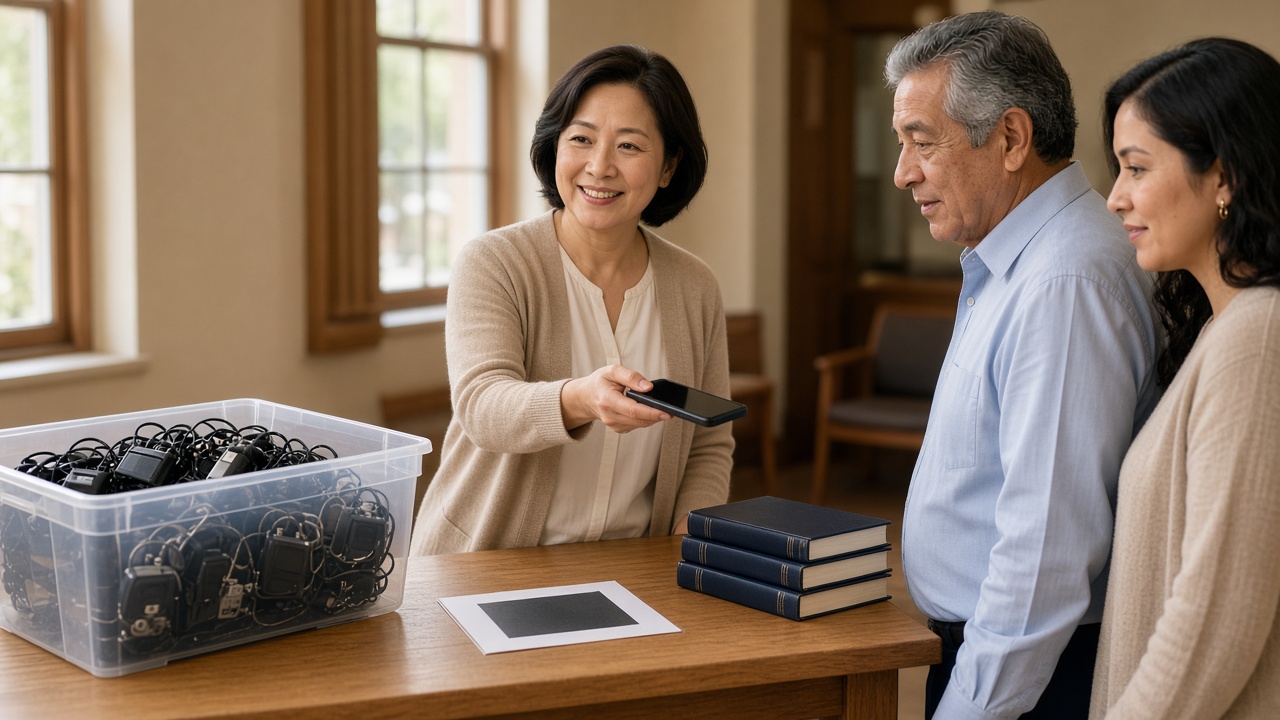
FM or RF interpretation systems. A human interpreter listens to the preacher and speaks into a transmitter. Listeners check out a church-owned receiver and hear that one interpreted channel. Infrared kits work the same way with light instead of radio. These systems do not need guest internet. They do need a charged pack for every person, and they usually need an interpreter for every language.
Interpreter booths and platform interpretation. A person stands beside the preacher or works from a booth. The room hears two voices, or the second voice is sent only to headsets. This is a staffing model more than a hardware model. If you are weighing a human voice against AI for a given hour, see Live Translation vs Human Interpreter. Here the question is how listeners receive the second language.
Assistive listening. Hearing loops, induction systems, and some of the same FM packs help people who cannot hear the house mix. That is accessibility for hearing, not language. A receiver that raises the English volume is not a Spanish sermon. Deaf and hard-of-hearing members need captions or a hearing system—not a second-language channel.
Consumer translator earbuds. Pocket gadgets and two-person earbud sets hear the room, not a clean board feed. They are built for a conversation at a table. They do not scale to a sanctuary.
Phone-based live translation is a fifth model: the host captures the speaker once; guests follow on the phones they already carry.
How an FM receiver Sunday actually works
A typical receiver Sunday has more moving parts than the product photo shows.
Someone has to interpret. If that person is sick, traveling, or already covering children’s ministry, the channel goes quiet. Adding Korean to a Spanish channel is not a setting. It is another interpreter, often another transmitter, and another labeled set of packs.
Someone has to run the closet. Receivers are charged or given fresh batteries on Saturday. Greeters hand them out, collect them, wipe earpieces, and chase the unit that left in a coat pocket. Latecomers get whatever is left.
What FM does well is simple audio for people who will not take out a phone. No QR code. No data plan. No “which app?” conversation at the door. If your building has no usable guest Wi-Fi and weak cell coverage, radio still wins on reliability. What it cannot do is captions. A receiver is one audio channel.
How phone-based live translation works
In the phone model, the church does not own a fleet of listener radios.
The host starts a broadcast from a laptop or phone and feeds it clean audio—ideally from the mixer, not an open mic at the back of the room. Listeners scan a QR code or open a link, pick a language, and read live captions, listen to an AI voice, or both. They do not create an account. The same code can serve Spanish next to Korean next to Portuguese.
Hope Translator is built this way: live transcription and translation, broadcast (one speaker to many listeners) or solo / conversation (one-to-one), on web and mobile. Attendees join with a QR code or link.
The tradeoff is connectivity. The host needs a stable internet connection. Guests need their own data or church Wi-Fi. Phones also ask something FM does not: a person must unlock a device, scan, and (for audio) put in earbuds. First-time visitors do that more readily when a greeter hands them a card and, if needed, a cheap wired headset. That headset is optional loaner gear, not a radio system.
Phones add something receivers never did. A mixed-language family can sit together. A teenager follows in English. A grandmother reads Spanish. A visitor who arrived without warning still has a language on the list. You are not guessing how many packs to charge for a language you did not staff.
Side-by-side: receivers vs phones
| Decision | FM / RF receivers | Phones | | --- | --- | --- | | Who translates | A human interpreter per language | AI captions and voice from one host session | | What the guest holds | A church-owned pack and earpiece | Their own phone (optional loaner headset) | | Adding a language | Another interpreter, often more hardware | The guest picks it | | Adding 40 more listeners | Buy and charge 40 more units | Nothing changes | | Works with no guest internet | Yes | No — guests need data or Wi-Fi | | Captions as well as audio | Usually no | Yes | | Saturday / Sunday labor | Charge, label, hand out, collect, clean | Print a QR card; brief the greeter | | Best first fit | One stable language, reliable interpreter, weak connectivity, people who will not use phones | Visitors, mixed families, several languages, captions |
This is not a scorecard where one column should win every row. It is a map of what you are actually buying.
When FM receivers still make sense
Keep the packs—or buy them—when the ministry is already shaped around them.
The building cannot carry phones. If sanctuary Wi-Fi is unusable and cell service drops in the pews, a radio channel is the honest tool. Do not replace a working offline system with an app that cannot reach the back row.
Your people will not take out a phone. Some older members, some refugee households, and some congregations with a strong “phones away” culture will accept a handed receiver and refuse a QR code. Forcing a device on them is not hospitality.
You already paid for the closet, and one language is stable. If a trained interpreter shows up every week, the packs are paid off, and the same twenty people use the Spanish channel, the incremental cost of another Sunday is batteries and time. Replacing that with software just to look modern wastes a system that already works.
The same packs are also assistive listening. If members already know “channel 2 is louder English,” do not take that away. Language translation and hearing support can share a habit even when they are different jobs.
If the real ministry question is whether this English hour should carry other languages at all—or whether you should plant a second-language service—that is a different decision: Spanish service vs live translation.
When phones are the better first purchase
Phones win when the hard part is unpredictable people, not radio engineering.
Visitors you cannot staff for. A Korean family at an English church, a Portuguese guest at a wedding, a Ukrainian student at Easter—you will not have a charged pack and an interpreter ready for every surprise. A QR code does not need a forecast.
More than one or two languages. Hardware multiplies per channel. A phone list does not. Churches that keep adding “just one more language” to the receiver closet eventually run a warehouse.
You want text, not only a second voice. Children learning to read a new language, guests who process print faster than speech, and deaf or hard-of-hearing members who need captions all get something a bodypack cannot show.
You do not have a Saturday equipment team. If the same two greeters already run coffee and the nametag table, adding a charging-and-checkout ministry is how translation dies in January. A card in the bulletin is a smaller job.
You are comparing cost to interpreters and kits, not to “free.” Human interpreters commonly run $50–$200+ per hour, per language, often with two-to-four-hour minimums. Equipment rental or purchase in our live translation cost guide is often $500–$5,000+ depending on the setup. Hope Translator’s published starting plan is $20/month for 5 hours. Confirm current tiers on pricing. Listeners pick from 44 output languages on one session; plans set how many can run at once. Guests do not pay.
The hybrid most churches should consider
You do not have to throw out a working closet.
Keep FM or infrared packs for the people who already rely on them. Add a phone broadcast for guests, mixed-language households, and languages you will never staff. The preacher still speaks once. The mixer still sends one clean feed. Two listening paths can share that feed without making the sanctuary choose a tribe.
What you should not do is buy a second radio language “just in case” while visitors sit through English they cannot follow. Spare hardware in a tub is not hospitality. Neither is an unused QR code on a slide nobody explains.
Hope Translator does not replace your interpreter for counseling, membership interviews, or other high-stakes conversations. Use a qualified human there. Use live translation so the public sermon and announcements are followable this week—on phones, and beside the receivers you already own.
Choose the path that matches this month
If your sanctuary has no signal, your people will not use phones, and one interpreter already carries one language well, keep the receivers. Buy batteries, not a new category of software.
If your next problem is a visitor, a mixed family, a second language, or a greeter team that cannot run a checkout desk, do not buy another tub of packs. Put a clean audio feed into a broadcast and let people use the phones they brought.
Ready to try the phone path in the service you already run? Start a session at hopetranslator.com or compare plans on pricing. For the sermon-side workflow after you choose phones, see church live translation for sermons.