Why Church Volunteer Interpreters Burn Out
She is already in the building. That is how the church explains the language plan.
Someone greets in Spanish at the door. Someone whispers the sermon from a side chair. Someone stays after the blessing to explain the newcomer lunch, the kids check-in, and the prayer request card. It is often the same person. By noon she has worked a second shift that never appeared on the volunteer roster. Next month she will ask to sit with her family. Leaders will be surprised. The guests who needed her will already be gone.
This is not a recruiting problem first. It is a ministry design that treats bilingual membership as a free interpretation department. Burnout is what that design produces.
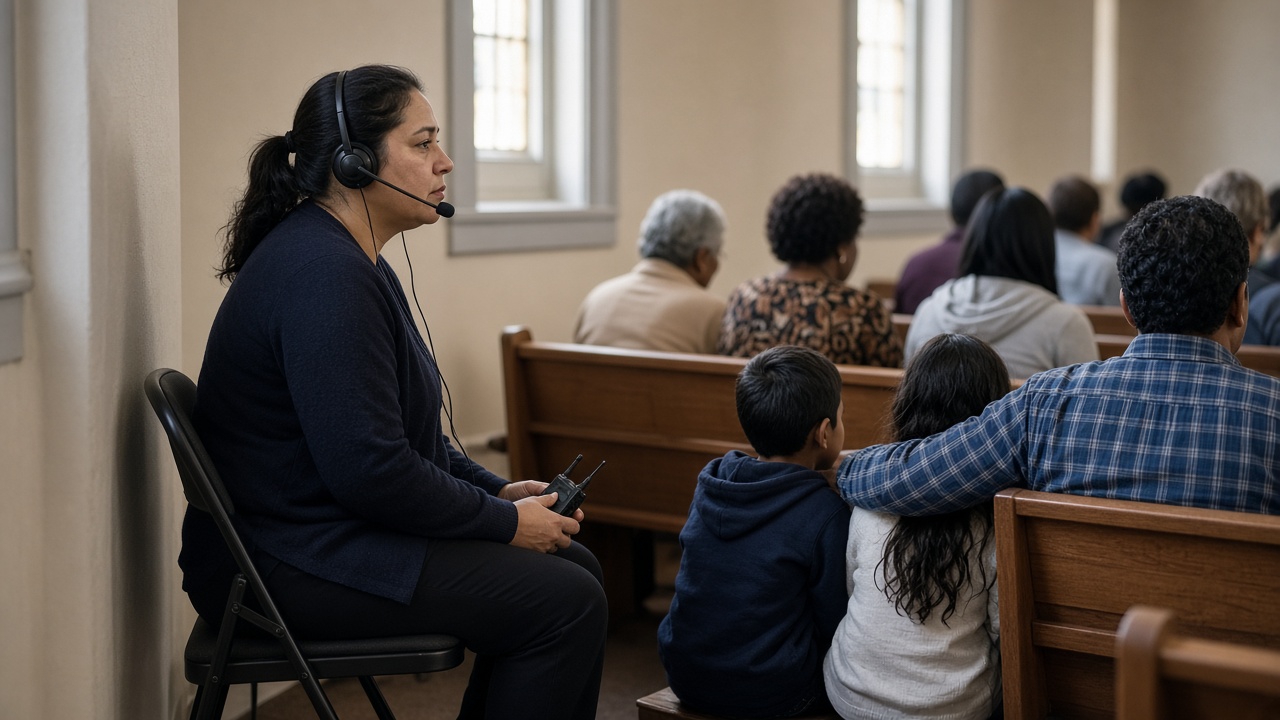
The church did not hire an interpreter. It borrowed one.
Most congregations never vote to start an interpretation ministry. They notice a family that cannot follow English, remember who speaks Spanish or Korean, and ask a favor. The favor works. So it happens again. Within a season, “Maria can do it” has become the language strategy.
That story feels like hospitality. It is actually a staffing model with one name on it.
Speaking two languages is not the same gift as interpreting a live sermon. Interpretation means listening, holding meaning, choosing words, and speaking—while the preacher is already on the next sentence. Humor, Scripture names, and church shorthand all have to land in time. A bilingual greeter can do that for a hallway conversation. An hour of simultaneous work is a different job. Professional conference interpreters treat it that way. The International Association of Conference Interpreters (AIIC) describes simultaneous work as requiring intense concentration, with interpreters typically working in pairs and taking turns about every 20 to 30 minutes. Churches often ask one volunteer to cover the whole service, then the lobby.
If the person says yes, leaders conclude the need is met. The volunteer concludes that every language need in the building now routes through them.
What the invisible job actually includes
The title is “can you interpret today?” The work is larger.
The spoken hour. Thirty to forty minutes of preaching, plus announcements, plus the next-step invite. Consecutive interpretation doubles the length of the room. Simultaneous interpretation from a chair or booth does not, but it costs the interpreter the chance to worship. Either way, the volunteer is working while everyone else is receiving.
The unplanned extras. A parent asks whether children’s ministry has anyone in Spanish. A guest needs the connect card explained. Someone wants prayer in their language after the service. None of that was on the ask. All of it finds the same person, because they are the one who “does language.”
The midweek remainder. A new-member class, a funeral, a text asking for a flyer in Korean. Print translation is not live interpretation, but churches rarely keep those jobs in separate columns. The same name gets both.
The guilt layer. Last-minute “can you cover?” sounds small. Repeated, it teaches the volunteer that saying no will leave people without the Word. That is not a schedule. It is a trap.
When churches later say they have an interpretation ministry, they often mean they have a person. Persons get sick, travel, serve on the worship team, and eventually protect their own Sunday. A ministry that cannot survive one absence was never a ministry. It was a favor with a long memory.
That is also why visitors cannot count on it. First-time guests who cannot follow the hour rarely come back—and they will not know that the usual interpreter was at a niece’s recital.
Burnout is the symptom. The model is the cause.
Better volunteer management still matters. A published rotation, sermon notes in advance, a backup, and permission to decline without a speech are acts of care. They will not save a model that still requires a bilingual body in a chair for the public hour to exist.
Three assumptions keep the model in place.
Assumption one: bilingual people enjoy this. Some do. Many do not. They said yes because they love the church, not because simultaneous interpretation is their calling. Using a gift without naming the cost is how churches lose the people who were doing the quiet work.
Assumption two: if we recruit two more, the problem shrinks. It shrinks only if the job shrinks. If every Sunday still needs a live human voice for every target language, you have built a booth schedule you cannot staff. Adding Korean to a Spanish channel is not a setting. It is another person, another fatigue cycle, another single point of failure.
Assumption three: software cannot belong near a sermon. That is a category error. Live translation of a public hour is not pastoral counseling. It is a way for people already in the room to follow what is being said. The question is not whether a machine can be a shepherd. The question is whether the congregation’s access to the preached Word should depend on one volunteer’s stamina.
If the deeper issue is whether this English hour should carry other languages at all—or whether a Spanish, Korean, or Mandarin congregation needs its own service—that is a different decision: Spanish Service vs Live Translation. Burnout is often the alarm that the current shape is pretending to be both.
Split the jobs churches have fused
Healthy multilingual churches separate work that got glued together by accident.
Following the public hour is access. The sermon, the announcements, and the “join us next” have to be followable without booking a person and without announcing yourself as a problem. That is a systems job. It should work when the usual volunteer is out. Hardware in the pew—FM packs versus phones—is a separate choice; see church translation equipment vs phones. The point here is narrower: access cannot be a person.
Being a person in someone’s language is ministry. Greeting, sitting with a family, praying, explaining baptism, showing up at a hospital. Software does not do that. The bilingual member who was burned out on Sunday interpretation is often the right person for this—if they are not already spent.
High-stakes conversations still need a qualified human. Counseling, membership interviews, and legally sensitive meetings are not a live-caption problem. If you are weighing a human voice against an overlay for a given hour, start with live translation vs a human interpreter. Do not ask a volunteer to be both the booth and the pastor.
When those jobs stay fused, the church gets neither. The volunteer cannot worship. The guest cannot count on next week. The elders think language is “covered.”
Where live translation belongs in the new model
Live translation is the overlay that makes the hour you already run followable. The pastor still preaches once. Listeners follow in their language. It is not a second congregation, and it is not a substitute for bilingual pastoral care.
Hope Translator is built for live transcription and translation of speech—on the web and in the mobile apps—with broadcast (one speaker, many listeners) and solo / conversation (one-to-one) modes. A tech volunteer or greeter can host. People scan a QR code or open a link, pick a language, and read captions, listen to an AI voice, or both. They do not create an account.
That is the right tool when the people who need another language are already in the room—or might walk in without the interpreter on the roster. It is the wrong tool when what they need is a church that lives in their language all week.
Use it so the bilingual member can sit in a pew. Keep the human for the conversations that should never have been added to the interpretation shift. For the sermon-side workflow once you decide the hour should be followable even when a volunteer is out, see church live translation for sermons.
Cost is not the moral argument, but it is why churches stay stuck on one name. Published ranges for a human interpreter are $50–$200+ per hour, per language, often with 2–4 hour minimums. Hope Translator’s published entry benchmark is $20/month for 5 hours. Confirm current tiers on pricing. A plan will not thank your interpreters. It can stop asking them to miss worship in order for anyone else to have it.
Let them sit down
If your language access disappears when one person takes a Sunday off, you do not have a language ministry. You have a person you have not yet lost.
Thank them. Narrow what you ask of them. Put the public hour on a system that does not require their body in a chair. Then give them back the gift they were quietly spending: a Sunday in which they can listen.
Ready to make the hour followable without borrowing the same volunteer every week? Start a session at hopetranslator.com or compare plans on pricing.