What Languages Does Your Church Neighborhood Speak?
The elders’ meeting has a feel for the neighborhood. Someone mentions the bakery on the corner. Someone else mentions the one Spanish-speaking family that visits at Easter. The language plan, if there is one, is built from those two memories.
The American Community Survey already published a different picture for that ZIP code. This is not a tutorial for clicking through census.gov, and it is not a setup guide. It is about the gap between the languages that live around the building and the language Sunday actually uses—and what those numbers are good for before you treat them as a ministry vote.
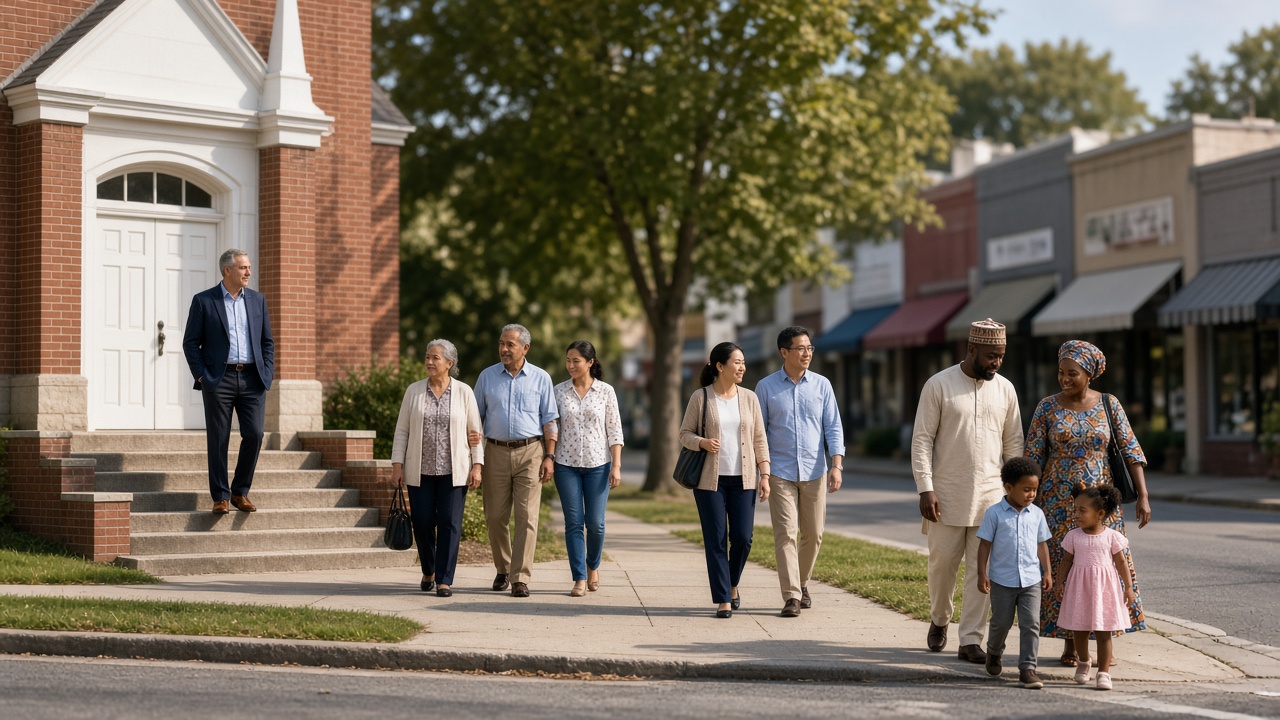
Sunday is a sample, not a census
The people who already found your church are not a random draw from the tract.
A service held only in English is a filter. Households that cannot follow the hour often never sit down. Households that can shop in English but think in another language may sit once, smile, and not return. First-time guests who cannot follow the sermon rarely come back. The kids check-in line is a second filter: if children's ministry is English-only, mixed-language families often decide before anyone sits down. See English-Only Children's Ministry Is a First-Sunday Filter. What leaders see in the pews is the group that survived the filter—not the group that lives within a ten-minute drive.
That is why “we don’t have those people” is a weak reading of a multilingual ZIP code. You may not have them yet because the hour is unintelligible. The Census table is not proof they will come. It is evidence they are already nearby.
What the national numbers actually say
The latest detailed national snapshot from the U.S. Census Bureau’s 2023 American Community Survey 1-year estimates is not subtle.
Among people age 5 and older:
- 22.5% spoke a language other than English at home—about 71.1 million people.
- 8.7%—about 27.6 million—spoke English less than “very well.” That is the Census definition of limited English proficiency (LEP).
- Spanish was the largest language group: about 43.4 million speakers (13.7% of people age 5 and older). About 17.6 million Spanish speakers were LEP.
The same table groups the rest of the country into large bands: other Indo-European languages (about 12.4 million), Asian and Pacific Islander languages (about 11.3 million), and other languages (about 4.0 million). Those bands hide Korean next to Vietnamese, and Arabic next to many smaller languages. National totals are a ceiling, not your church.
A slightly older Census Bureau release, the 2018–2022 ACS 5-year estimates, is useful for the next-most-common languages. Among people who spoke a language other than English at home, Spanish was 61.1%, Chinese (all dialects) 5.1%, and Tagalog (including Filipino) 2.5%. In that same period, most Spanish speakers and most Tagalog speakers still spoke English “very well.” Less than half of Chinese speakers did.
Those are not church surveys. They are household answers to three questions: Do you speak a language other than English at home? Which one? How well do you speak English? Federal agencies use the answers to plan language assistance. Churches can use the same tables without pretending the ACS is a visitor card.
The phrase that fools planning teams
“Speaks a language other than English at home” is not the same sentence as “needs a translator on Sunday.”
A teenager who speaks Spanish with grandparents and English at school is in the 71 million. So is a grandmother who follows almost none of an English sermon. The LEP number—English less than “very well”—is the closer proxy for who cannot follow a 40-minute homily. Even that is imperfect. “Very well” is a self-rating. A person can work a job in English and still lose a theological argument at pulpit speed.
Mixed households are the other blind spot. One address can hold an English-fluent adult, a parent who is LEP, and children who switch between both. A second-language service splits that pew. Overlay translation keeps it together. That is the decision in Spanish service vs live translation—and it is a household question, not a tract total.
If you only look at “language other than English,” you will over-build. If you only look at who already attends, you will under-build.
What a local table can tell you
For a county, city, or ZIP code tabulation area, start with table S1601 (Language Spoken at Home) on data.census.gov. For a small place, use the 5-year ACS, not the 1-year. The 1-year file is fresher and noisier. The 5-year file is what a suburban ZIP can actually support.
Read four cells before you read anything else:
- Share who speak only English at home.
- Share who speak a language other than English at home.
- Share who speak English less than “very well.”
- The largest named group—usually Spanish—and its LEP share.
Then stop. Detailed language lists (Korean, Vietnamese, Arabic, Portuguese) often appear only for larger geographies. A tract that “has no Korean” in the published table may still have Korean households the sample did not break out. Treat missing detail as a limit of the table, not as proof the language is absent.
Margins of error matter at church scale. A ZIP estimate of a few hundred speakers of one language, with a wide margin, is a signal to listen—not a headcount for a 1 p.m. plant.
This is the opposite of dashboard ministry. The table answers “which languages are near us?” It does not answer “who will stay if we translate the English hour?” or “who needs a church that shepherds in Spanish?”
Why the pews can still look English
Three ordinary mechanisms produce a monolingual Sunday in a multilingual tract.
The hour is the invitation. People who cannot follow do not keep visiting to “give it time.” They already gave you an hour.
Bilingual members absorb the gap. A volunteer greets, whispers, and explains the newcomer lunch—until they sit with their own family. That model has a name and a breaking point; see why church volunteer interpreters burn out.
Leaders trust anecdotes over the tract. The bakery and the Easter visitors are real. They are also a tiny sample. Census language data will not tell you a family’s story. It will tell you that Spanish-plus-Korean-plus-Portuguese is a more honest prior than “we might need Spanish someday.”
None of this means the tract is the congregation you are called to plant. Some churches are regional. Some draw a commuter campus. Some sit next to a language community they are not equipped to shepherd. The data still changes the default question from “do we have a language problem?” to “which languages are we currently declining to host?”
What the numbers should change—and what they should not
Use the table to:
- Name more than one language. If the ZIP is Spanish-heavy and the next band is Asian and Pacific Islander languages, “we should do something about Spanish” is incomplete. A broadcast can offer more than one output language in the same hour. A consecutive interpreter usually cannot.
- Separate overlay from planting. A large LEP Spanish population plus no Spanish-speaking pastor is a hospitality problem this Sunday, not a 12-month launch by itself. The plant question is still leadership, belonging, and discipleship—not a percentage on S1601.
- Prepare the lobby before the plant. Live sermon translation is how mixed families and first-time guests follow the service you already run. It is not a Spanish campus.
- Keep language access distinct from disability access. English captions help people who cannot hear the room. They do not help a family that can hear every word and cannot follow the language. That mix-up is language access vs accessibility.
Do not use the table to:
- Vote in a second service because a percentage looks large.
- Ignore Korean or Vietnamese because the published row is a language group.
- Treat bilingual teens as the interpretation plan.
- Confuse “people live here” with “people will come.”
Picture an English-speaking church in a first-ring suburb—an example, not a customer story. Table S1601 for the ZIP shows 18% speaking a language other than English at home, 7% LEP, Spanish as the largest named group, and a visible Asian and Pacific Islander band. Three households already sit in the English service and need another language. That picture does not require a new congregation this quarter. It does require that Sunday be followable in more than English.
Where live translation fits
Live translation is the hospitality layer while you learn what the neighborhood will actually do with an intelligible hour.
Hope Translator is built for live transcription and translation of speech—on the web and in the mobile apps—with broadcast (one speaker, many listeners) and solo / conversation (one-to-one) modes. Listeners join with a QR code or a link, pick a language, and read or listen on their own phones. They do not create an account. Current output languages are on the supported languages page; current plans are on pricing.
That is the right tool for the public hour: the welcome, the sermon, the announcements, the next-step invite. It is the wrong tool for pastoral counseling, membership interviews, and other conversations that need a qualified human interpreter. Speech translation also does a poor job of hymns. Translate the spoken service.
If you only needed one language and you already have a trained interpreter who can last the hour without disappearing from their own pew, a human may still be the voice you want. If you need Spanish and Korean this month, or you cannot staff a booth every Sunday, overlay translation is the model that matches the tract without pretending you planted a campus.
Read the tract. Then make Sunday followable.
The Census will not call your next elder. It will tell you that the neighborhood is already more multilingual than the room. The remaining choice is whether the hour stays a filter or becomes a place mixed-language households can actually sit.
If the people who need another language are already nearby—and some of them are already in the pew—start a session at hopetranslator.com or compare plans on pricing.