Why Church Visitors Don't Come Back When They Can't Follow the Service
A family visits on Sunday. The greeters are kind. Someone finds them a seat. After the blessing they smile, shake a few hands, and walk to the parking lot. They do not come back.
From the platform, the visit looked fine. The problem was not a cold lobby. They sat through an hour they could not follow. The sermon, the announcements, and the “join us next” all happened in a language they do not think in. Friendliness got them in the door. Access is what decides whether they return.
This is the visitor-retention problem, not a setup tutorial. The same pattern shows up whether the room is English and the guests think in Spanish, or the church is Korean and a spouse thinks in English.
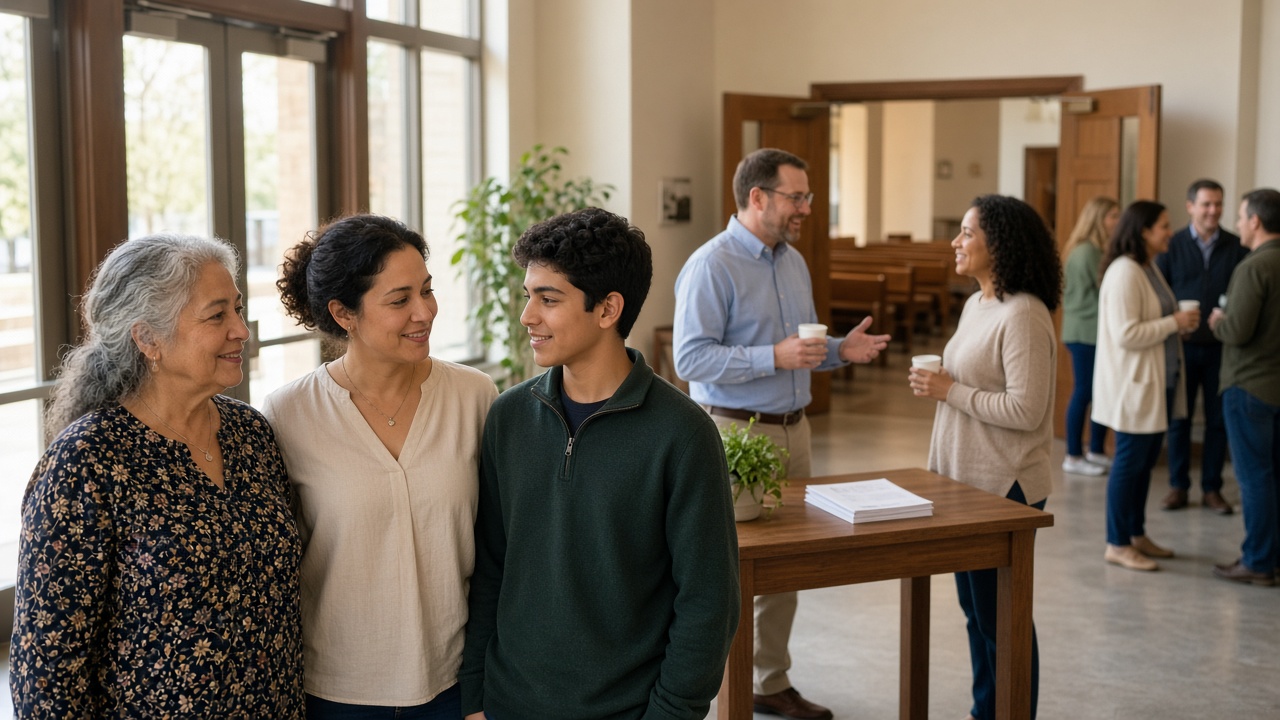
What the platform sees, and what the guest lived
Pastors remember the handshake. Guests remember the hour.
If you speak the language of the room, a first Sunday is already work: new faces, a bulletin you do not know how to read, a kids check-in line, and a sermon that assumes you know the last series. If you do not speak that language, the same hour is a performance you cannot join. You can nod. You cannot decide whether this church is for you.
Visitor studies often find that a welcoming first impression and a clear, followable message are two of the strongest reasons people give a church a second Sunday. Lifeway Research’s 2018 summary of guest impressions put “a clear, relatable message” among the things that matter most—and that was about English-speaking guests who still get lost in church jargon. A guest who cannot follow the spoken hour has a harder version of the same problem. They did not hear a weak sermon. They did not hear a sermon.
The Biblical Leadership essay “The missing ingredient in multilingual churches” describes a pattern many pastors recognize: interpretation or classes are offered, people still leave within weeks. The analysis there is that language access without belonging is not enough. That is true. It is also true that belonging never starts if the first hour is unintelligible. You cannot disciple someone who could not tell what you said.
The first Sunday has more than one language wall
The sermon is the obvious wall. It is not the only one.
The spoken hour. Forty minutes of preaching in a second language is exhausting even for someone who can shop and work in English. Theological words, humor, and Bible names arrive too fast to reconstruct. A printed outline in English does not rescue a guest who cannot read it at pulpit speed.
The next-step minute. “Fill out a connect card.” “Newcomer lunch is in the chapel.” “Kids stay in the gym for the second hour.” Those sentences decide whether a family knows how to come back. If they only understood the welcome at the door, they leave with no map.
The after-service cluster. Coffee is where belonging starts for people who already speak the language. For everyone else it is a room of conversations they cannot enter. A greeter who said “we’re glad you’re here” at 10:00 cannot replay the sermon at 11:15.
The mixed household. A teenager follows in English. A parent or grandmother does not. They sat together, which looked like success from the aisle. In the car, one person can talk about the message and the others cannot. That is how a family decides the next church will be the one where nobody has to sit through silence.
None of this requires a rude volunteer. It only requires a service designed as if everyone in the pews already belongs to the language of the pulpit.
Friendliness is not the same as access
Churches that care about guests often do the first layer well and stop there.
A “Bienvenidos” banner is a sign, not a sermon. A welcome card in two languages is useful if the guest can also follow the hour that card is about. A bilingual member who chats at the door for ninety seconds has already used the only language help many churches have planned.
Printed sermon notes in another language help when they exist, when they match what was actually preached, and when the guest received them before the first sentence. They fail when the pastor goes off outline, when the notes are last week’s, or when nobody thought to print Korean because the family was a surprise.
Asking the guest to “just let us know if you need translation” puts the burden on the person who already feels like an interruption. Many will smile and say they are fine. They are not coming back to ask again.
Access means the guest can follow the public hour without booking a person and without announcing themselves as a problem. Hospitality that depends on the right volunteer being free at the right door is not a plan. It is a hope.
“We have someone who can interpret” is not a visitor plan
A bilingual member is a gift. They are also a single point of failure.
Interpreting a live sermon is skilled, tiring work. The same person is often asked to greet, find children’s ministry, translate the announcement, and stay for prayer. If they are sick, traveling, or already on the worship team, the language channel disappears. The visitor does not know the channel was ever supposed to exist.
Last-minute “can you translate today?” is how churches discover they never had a system. It is also how the volunteer learns that every language need in the building is their unpaid second shift. When they step back, leaders are surprised. The guests who needed them already voted with their feet.
If the real question is whether this English hour should carry other languages at all—or whether you should plant a second-language service—that is a ministry-shape decision: Spanish Service vs Live Translation. If the question is hardware in the pew, see Church Translation Equipment vs Phones. Here the question is narrower: can an unexpected guest follow this Sunday if the usual person is not standing at the door?
What actually helps a guest consider Sunday two
You do not need a campaign. You need the first visit to be followable.
They can follow the spoken hour in a language they think in. Captions, a second voice, or both. Not a summary emailed on Tuesday. The decision to return is made before the parking lot.
They can sit with the people they came with. Splitting a mixed-language family between an English sanctuary and a hallway is a tax on the household. Each person following on their own phone is how a family stays in one pew.
They catch one next step. Newcomer lunch, a midweek group, “talk to the person at this table.” If that sentence is only in the pulpit language, the rest of the hospitality work is invisible.
They are not singled out. A QR code or link that anyone can use is quieter than a greeter escorting them to “the Spanish section.” Some guests want to be invisible on Sunday one. Give them a way to listen without becoming a project.
Someone still talks to them like a person. Live translation does not replace a human conversation after the service. It makes that conversation possible, because the guest now has something to talk about.
Where live translation fits—and where it does not
Live translation is the overlay that makes the hour you already run followable. The pastor still preaches once. Listeners follow in their language. It is not a second congregation, and it is not pastoral care.
Hope Translator is built for live transcription and translation of speech—on the web and in the mobile apps—with broadcast (one speaker, many listeners) and solo / conversation (one-to-one) modes. A tech volunteer or greeter can host. Guests scan a QR code or open a link, pick a language, and read captions, listen to an AI voice, or both. They do not create an account.
That is the right tool when the people who need another language are already in the room—or might walk in without warning. It is the wrong tool when what they need is a church that lives in their language all week. Translation of Sunday will not visit a hospital, lead a small group, or walk someone through baptism. Do not ask software to be a shepherd.
Use a qualified human interpreter for counseling, membership interviews, and other high-stakes conversations. If you are weighing a human voice in the room against an overlay for a given hour, start with Live Translation vs Human Interpreter. For the sermon-side workflow once you decide the hour should be followable, see church live translation for sermons.
Cost is not the main argument here, but it is why churches delay. Published ranges for a human interpreter are $50–$200+ per hour, per language, often with 2–4 hour minimums. Hope Translator’s published entry benchmark is $20/month for 5 hours. Confirm current tiers on pricing. A plan will not make a guest feel known. It can keep the first hour from being the reason they never come back.
A first-Sunday test for leaders
Before you buy anything, walk last Sunday as a guest who does not speak the pulpit language.
- Could they follow the sermon without a pre-arranged interpreter?
- Could they understand one next step without asking a stranger to repeat it?
- Could a mixed-language family stay in the same row?
- If your bilingual volunteer was out, what actually happened for a visitor?
- Did anyone explain that translation existed—or did you assume they would ask?
If the honest answers are no, the problem is not that your people are unfriendly. The problem is that hospitality ends at the door. Fix the hour, then keep doing the human work that software cannot do: remember their name, invite them to a table, and—if a language community is forming—ask whether a second-language service is the next calling, not a substitute for this Sunday.
Ready to make this Sunday followable? Start a session at hopetranslator.com or compare plans on pricing.