Should Your Church Translate Every Sunday or Only Special Services?
The elders approve translation for Christmas Eve, Easter, and Missions Sunday. Those nights look multilingual. Then January arrives. The grandmother who could not follow English in December is still in the third row. The new neighbor who visited in March gets a kind handshake and an hour he cannot use. The plan, if anyone asks, is still “we translate on the big Sundays.”
That is a cadence decision, not a setup tutorial. The question is whether language access is a standing promise or a special-event exception.
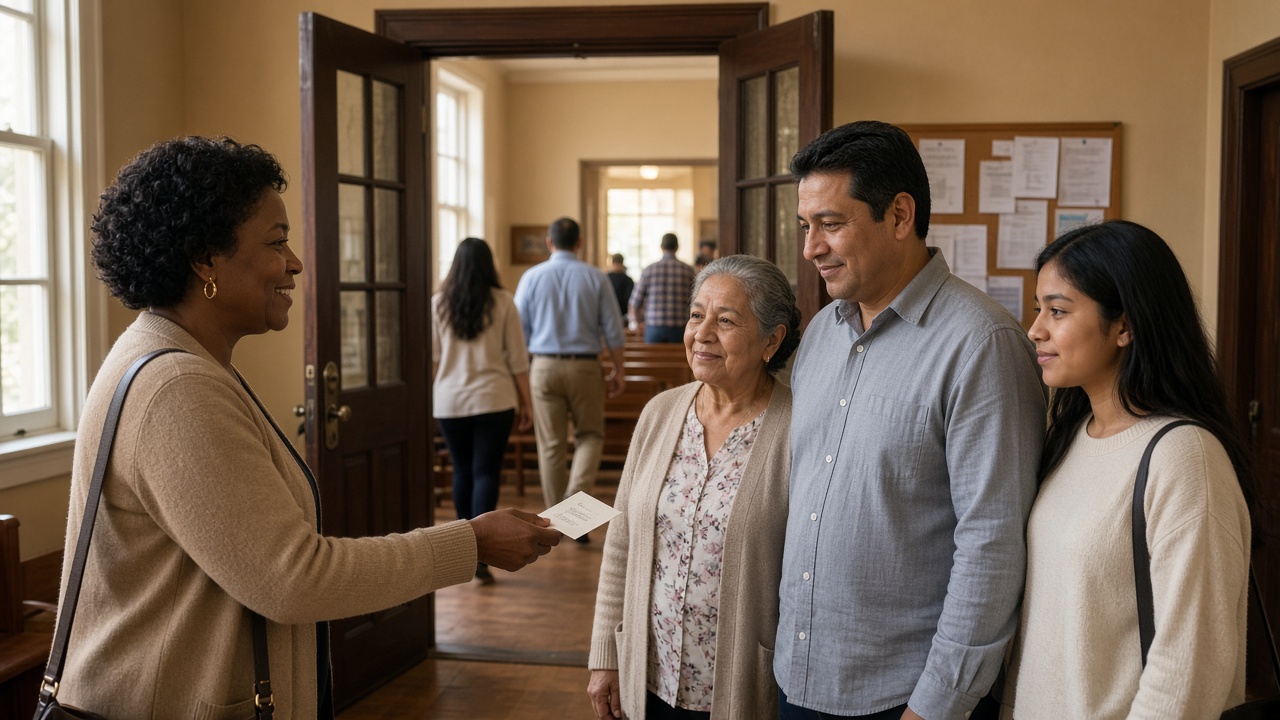
Special-service translation feels like a plan
Churches land here for ordinary reasons.
The room is most mixed on the nights everyone already knows to invite family. Volunteers will give an extra hour in December. The budget looks like an event line, not a ministry. And if the pews look English in February, “we don’t have those people yet” sounds like discernment.
It is also how a church can feel responsible without changing the fifty Sundays that actually form the congregation. A candlelight service with a QR code is visible hospitality. An untranslated ordinary Sunday is the week most visitors will get.
Christmas Eve really is a wider language mix. The ideas for that night belong in 7 Ways to Make Christmas Eve Multilingual. They are not a yearly language strategy.
What a holiday-only plan actually teaches
Access that appears three times a year trains three audiences at once.
Guests learn that this church is followable only when it is performing. A first-time family that comes on a random Sunday does not know you had Spanish audio on December 24. They know they sat through silence. First-time guests who cannot follow the hour rarely come back to discover that Easter will be different.
Members who need another language learn to endure. A mixed household can survive a holiday overlay and still spend the year with one person talking about the sermon in the car and the others nodding. Special Sundays do not disciple anyone. They prove the church can do it when the room is full.
Bilingual volunteers learn that “language” is a festival job. The same person who already greets, whispers, and explains the newcomer lunch gets asked to cover the nights that matter. Then leaders are surprised when the volunteer is tired in January. That pattern has a name: why church volunteer interpreters burn out. A holiday booth does not fix a weekly design problem. It concentrates it.
You also never get evidence. If translation exists only when the sanctuary is packed with in-laws, you cannot tell whether weekly access would change who stays. You can only tell that the big nights looked better on Instagram.
The real question is the promise, not the calendar
Cadence is a hospitality promise wearing a schedule.
If the promise is “anyone who sits down can follow the public hour,” it has to be weekly. People do not visit on your production calendar. Mixed families do not become monolingual between Epiphany and Advent. A neighborhood that already speaks other languages at home does not wait for your candlelight service; see what languages your church neighborhood actually speaks.
If the promise is “we will try on the nights the room is most mixed,” say that. Then accept the cost: ordinary visitors, midweek newcomers, and the household that sits with you in July are outside the promise. That can be an honest season while you decide something else. It is not the same sentence as “we are a multilingual church.”
Churches blur those sentences because the holiday plan is easier to vote for. Nobody has to change next Sunday.
When weekly translation is the right call
Choose a standing overlay—or start there—when most of the following are true.
The people who need another language already sit in the service you run, or they walk in without warning. Mixed families would be split by a second hour, or they already sit together in silence. You do not have a trained interpreter who can last fifty-two Sundays without disappearing from their own pew. You need more than one language this year, not a single festival booth. And you want hospitality this Sunday, not after a launch committee reports in the fall.
A typical picture: an English-speaking church in a changing suburb. Two households need Spanish. A Korean-speaking grandmother sits with her daughter. A newcomer class has a couple who think faster in Portuguese. None of those groups fills a 1 p.m. plant. None of them only exists in December.
Weekly translation is also a discernment tool. If people start asking for prayer and teaching in another language, if a leader emerges, you have evidence. You did not have to guess from Easter attendance. If you later need a church that lives in Spanish, that is a different ministry—see Spanish service vs live translation. Overlaying the English hour every week does not postpone that calling. It keeps this Sunday from being unintelligible while you find out.
When a special-service plan is still honest
Keep translation on selected nights—and say so—when the need is actually occasional.
The only multilingual hour you host is Christmas, Easter, or a guest conference. You have no recurring mixed households and no walk-in pattern you can name. You are still deciding whether you are called to a second-language congregation, and Sunday overlay is a later step, not this quarter’s work. Or the job in front of you is a one-off: a funeral with international family, a baptism with visiting grandparents, a missions banquet. Those hours still deserve to be followable. They are not a weekly strategy just because you did them well.
Special-service translation is also honest when you would rather hire a human for one high-stakes night than run a thin overlay all year and call it care. A skilled interpreter on Good Friday can be the right voice in the room. That choice does not answer March. If you are weighing a human against an overlay for a given hour, start with live translation vs a human interpreter.
What is not honest is using the holiday plan as a substitute for a promise you are already making in the bulletin: all are welcome. Welcome that cannot follow the sermon is a greeting, not access.
The middle path churches miss
The choice is not “translate fifty-two Sundays like a conference” or “do nothing until Christmas.”
A practical pattern many congregations can run without pretending they planted a campus:
Make the spoken hour followable every week. Sermon, announcements, and the next-step invite. That is the public hour a guest uses to decide whether to return. Lyrics and liturgy can stay on a printed or projected sheet in the languages you already know. Live speech is what changes week to week.
Keep humans for the work software cannot do. Counseling, membership interviews, hospital visits, and the conversation after the blessing still need a person. Weekly overlay is not pastoral care. It is what makes pastoral care possible with someone who finally heard the hour.
Brief the big nights; do not invent a second system for them. Christmas Eve needs more cards, a loaner pair of earbuds, and greeters who already know the sentence. It should not be the first time the wireless pack meets the laptop.
Treat midweek as part of the same promise if people actually gather. A newcomer class or small group that is English-only while Sunday is translated still tells the guest the church is followable only in the sanctuary. You do not have to overlay every hallway conversation. You do have to notice when the next step is another English wall.
That middle path is how weekly access stays light. You are not staffing a booth. You are deciding that the hour you already run will not filter people out.
What weekly actually costs—and what it does not
Leaders often reject weekly translation because they price it like a human booth: one interpreter per language, every Sunday, plus fatigue. Published ranges for that work are $50–$200+ per hour, per language, often with 2–4 hour minimums. Do that fifty-two times and you have a five-figure line before you have hired a language pastor.
Live translation is a different cost shape. Hope Translator’s published entry benchmark is $20/month for 5 hours. Confirm current tiers on pricing. Five spoken hours is a realistic small-church month: a Sunday sermon plus announcements, with room for a midweek class. Listeners pick a language on one session. You are not paying a second invoice because someone needed Korean as well as Spanish. For the wider budget comparison, see how much live translation costs.
Weekly does not require a new production stack. It requires a habit: a clean audio feed, a host who can start a session, and a QR code or link that does not change every week. Guests do not create an account. The worker is the promise, not the software.
Weekly also does not mean you stop inviting people into a church that shepherds in their language. If the neighborhood needs a Spanish congregation, overlay is hospitality on the way, not the destination.
Where live translation fits
Live translation is the overlay that makes the hour you already run followable, including the unremarkable Sundays. The pastor still preaches once. Listeners follow in their language. It is not a second congregation, and it is not a Christmas pageant.
Hope Translator is built for live transcription and translation of speech—on the web and in the mobile apps—with broadcast (one speaker, many listeners) and solo / conversation (one-to-one) modes. A tech volunteer or greeter can host. Guests scan a QR code or open a link, pick a language, and read captions, listen to an AI voice, or both. They do not create an account.
That is the right tool when the people who need another language might walk in on a Sunday that is not on the special-event list. For the sermon-side workflow once you decide the hour should be followable, see church live translation for sermons.
If the honest answer is that your language plan is a holiday calendar, you already know the next decision. Either change the promise to match the calendar, or change the calendar to match the promise.
Ready to make an ordinary Sunday followable? Start a session at hopetranslator.com or compare plans on pricing.