7 Ways to Make Christmas Eve Multilingual
Christmas Eve is the most multilingual hour many churches will host all year. Grandparents fly in. Students come home. Neighbors who never visit on a normal Sunday show up because someone they love invited them. The sanctuary fills with people who do not share one language—and who did not get a year to learn your liturgy.
Most churches still plan that night as if the room already knows the choreography: when to stand, when the candles come out, what “the invitation” means. Language is treated as a later problem, or as a job for the one bilingual member who already works every Sunday. This is a list of ideas for the hour you already run—not a setup tutorial, and not a pitch to launch a second Christmas Eve congregation by December 24.
1. Keep mixed-language families in one pew
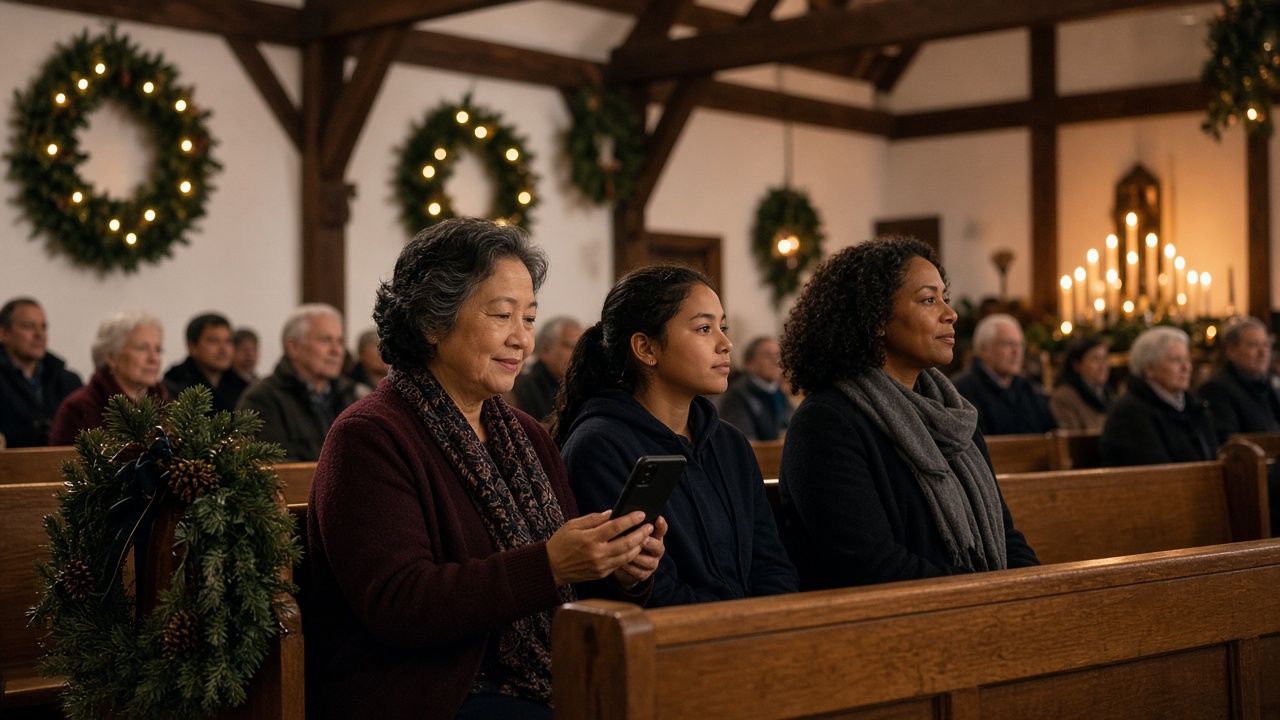
Christmas is a household holiday. A teenager who thinks in English brings a parent who thinks in Spanish. A Korean grandmother sits beside grandchildren who only know the English carols. The instinct to “send them to the Spanish service at 4:00” sounds hospitable. On this night it often splits the people who came together.
A second-language Christmas Eve is a real ministry when you already have Spanish-speaking leadership, worship, and pastoral care. It is a different project from overlaying translation on the English hour so a mixed family can stay in one row. If you are weighing those models for the rest of the year, start with Spanish service vs live translation. For Christmas Eve, the shorter test is: will this family sit together? If the answer matters more than launching a new congregation this month, keep them in one pew and let each person follow in their own language.
2. Translate the spoken hour, not only the sermon
The sermon may be twenty-five minutes. The visitor’s confusion starts earlier.
Welcome. Kids dismissal. The explanation of communion or candle lighting. Scripture read aloud. The invitation to come back on Sunday. Announcements about the offering, the coat drive, the 11:00 service still to come. Those are the minutes that tell a guest whether this room is for them. A church can preach clearly and still lose people in the scaffolding of the hour.
If first-time guests already leave ordinary Sundays because they could not follow, Christmas Eve multiplies the same problem: more strangers, more spoken instructions, less time to ask a neighbor what just happened. That retention pattern is the subject of why church visitors don't come back. The Christmas version is simpler. Whatever you say to the room in English, assume someone in a pew needs it in another language as it is spoken—not as a summary at the cocoa table afterward.
3. Put carols on paper. Do not ask a live translator to sing.
Live speech translation is built for continuous spoken language: a pastor at a microphone, a reader at the lectern. Congregational singing is a different acoustic problem. Organs swell. Voices overlap. People hum. “Silent Night” in a dark room is beautiful worship and a poor audio feed.
Print or project the lyrics. Many Christmas hymns already exist in Spanish, Korean, Portuguese, Mandarin, and German. A bilingual bulletin for Silent Night, O Come All Ye Faithful, and Joy to the World does more for sung worship than hoping a speech model will catch a candlelit verse. Save live translation for the spoken parts: the greeting, the readings, the homily, the invitation.
This is not a failure of the tool. It is matching the tool to the job. Sung liturgy wants a page. Spoken liturgy wants a live overlay.
4. Give greeters a language card, not an interpreter shift
The bilingual volunteer who interprets on ordinary Sundays cannot cover 4:00, 6:00, 8:00, and 11:00 on December 24—and still sit with her own family. Asking her to do it is how churches burn out volunteer interpreters on the night attendance peaks.
Hospitality on Christmas Eve is a door job, not a booth job. A greeter can hand a card with a QR code, point to a short line on the bulletin (“Follow in your language”), and keep moving. Visitors scan, pick a language, and read or listen on their own phone. They do not create an account. The person who speaks two languages can pray with someone in the lobby instead of missing four services in a chair.
If you already share translation that way on Sundays, the Christmas change is mostly volume and briefing: more cards, a loaner pair of wired earbuds at the welcome table, and one sentence every greeter can say. See how to share live translation with a QR code for the card itself. The idea here is who holds it: ushers, not the interpreter.
5. Plan for the room to go dark
Candlelight is the point of many Christmas Eve services. It is also when a front-of-room caption screen becomes a glowing rectangle nobody asked to stare at—and then becomes useless when the lights drop for Silent Night.
Personal phones win in a dark sanctuary. Each listener controls brightness, language, and whether they read captions, tap listen, or both. A shared projection is still useful earlier in the hour if most of the room needs the same language as text, but Christmas Eve is usually the opposite: most people follow English by ear, and a few households need a private overlay. That split is the reason to prefer devices in the pew. The longer decision framework is presentation screen vs personal devices.
One practical note: remind people, once, that phones on low brightness are welcome for translation. Otherwise guests hide the device because they think it looks rude—and then they cannot follow.
6. Staff a system for three services, not one heroic interpreter
Christmas Eve is a production day. Family service. Traditional service. Late candlelight. Each one has a different crowd. The 4:00 room may be full of children and visiting in-laws. The 11:00 room may hold night-shift workers and people who came from another church’s earlier service. You will not forecast every language.
Human interpreters are the right call for high-stakes liturgy in some traditions, and they are a poor staffing plan for three packed hours in languages you meet at the door. Published ranges for a human interpreter are $50–$200+ per hour, per language, often with 2–4 hour minimums. Three services and two surprise languages is a budget and a roster most churches do not have in December.
A live overlay does not need a forecast. One host session can serve listeners who pick different languages. Hope Translator’s published entry benchmark is $20/month for 5 hours—enough spoken time for a typical Christmas Eve slate if you are not also running a long Sunday morning the same weekend. Confirm current tiers on pricing. The point is not the invoice. The point is that access should survive the 6:00 service even if the 4:00 interpreter went home to put children to bed.
7. Make the cocoa table followable too
The service ends. Someone says, in English, that cookies are in the foyer, that Sunday is at 10:00, that children’s check-in is the north door, that the pastor would love to meet you. That is the second service of the night, and it has no bulletin.
If the only translated hour is the homily, the guest still leaves without a next step. Put the same QR near the cocoa. Brief two greeters to watch for people who are scanning the room rather than joining a conversation. For a true one-to-one—directions, a prayer request, a question about baptism—the mobile app’s solo / conversation mode is the better tool than broadcasting the whole lobby. The public hour stays in broadcast: one speaker, many listeners. The hallway is person to person.
Christmas Eve hospitality that stops at the blessing is a concert. Hospitality that continues at the table is how a once-a-year guest becomes a second Sunday.
What these ideas are not
They are not a bilingual Christmas pageant, a lessons-and-carols script in two languages, or a new Spanish-speaking congregation. Those are good work when you have the people to lead them. They take a different calendar than “we just noticed our 6:00 service will be full of families who do not think in English.”
They are also not a substitute for a qualified human in counseling, membership interviews, or any conversation your tradition treats as pastoral or sacramental in a way that should not run through a caption overlay. Use live translation so the public hour is followable. Hire a person for the conversations that should never have been added to an interpretation shift.
Where live translation fits on December 24
If the people who need another language will already be in your English (or Korean, or Portuguese) Christmas Eve, overlay translation is the model that keeps the household in one pew. The pastor still preaches once. Listeners follow in their language.
Hope Translator is built for live transcription and translation of speech—on the web and in the mobile apps—with broadcast (one speaker, many listeners) and solo / conversation (one-to-one) modes. A greeter or tech volunteer can host. People scan a QR code or open a link, pick a language, and read captions, listen to an AI voice, or both. They do not create an account. Listeners can choose from 44 output languages on one session; plans set how many languages can run at the same time.
Test it on an ordinary Sunday first if you can. Christmas Eve is a poor night to discover that the wireless pack is dead. If you cannot test on a Sunday, run a short rehearsal with last year’s homily and the actual microphone you will use.
Ready to make Christmas Eve followable for the families who will only sit in your pews once this year? Start a session at hopetranslator.com or compare plans on pricing.