Why Live Translation Cannot Follow the Worship Songs
The demo looks fine during the welcome. Captions land. Spanish audio stays a thought behind the pastor, the way live translation always does. Then the band starts. The phone fills with fragments, half-words, and a line that is not in the song. Someone on the tech team mutes the session. The elders conclude that live translation does not work.
It did the job it was built for. Sung worship is a different job.
This is not a setup tutorial. It is the evaluation question churches hit the first time they try a speech translator on a Sunday that includes a praise set: if the sermon overlay is usable, why does the same tool fall apart when people sing?
Speech recognition is trained on talking
Live AI translation is a pipeline, not a musician.
- Speech recognition turns audio into text in the speaker’s language.
- Machine translation turns that text into the listener’s language.
- Optional text-to-speech reads the line aloud.
If step 1 never hears a sentence, step 2 cannot recover a lyric. Accuracy in 2026 is strongest on one clear speaker and continuous spoken language: a sermon, a reading, a conference talk. Recognition models are trained on that kind of audio—consonants, pauses, conversational rhythm, one mouth close to a microphone.
Singing is a different acoustic object. Vowels stretch. Pitch replaces the speech contours the model expects. Harmonies stack. The same word can last two measures. A recognizer that is excellent on a pulpit mic will still guess when the input is melody.
That is why a mix-minus, speech-only feed helps the sermon and still cannot make a hymn behave like a paragraph. Isolating the vocal channel removes drums and pads. It does not turn singing into speech.
The room is writing several tracks at once
A typical Sunday set is polyphonic on purpose.
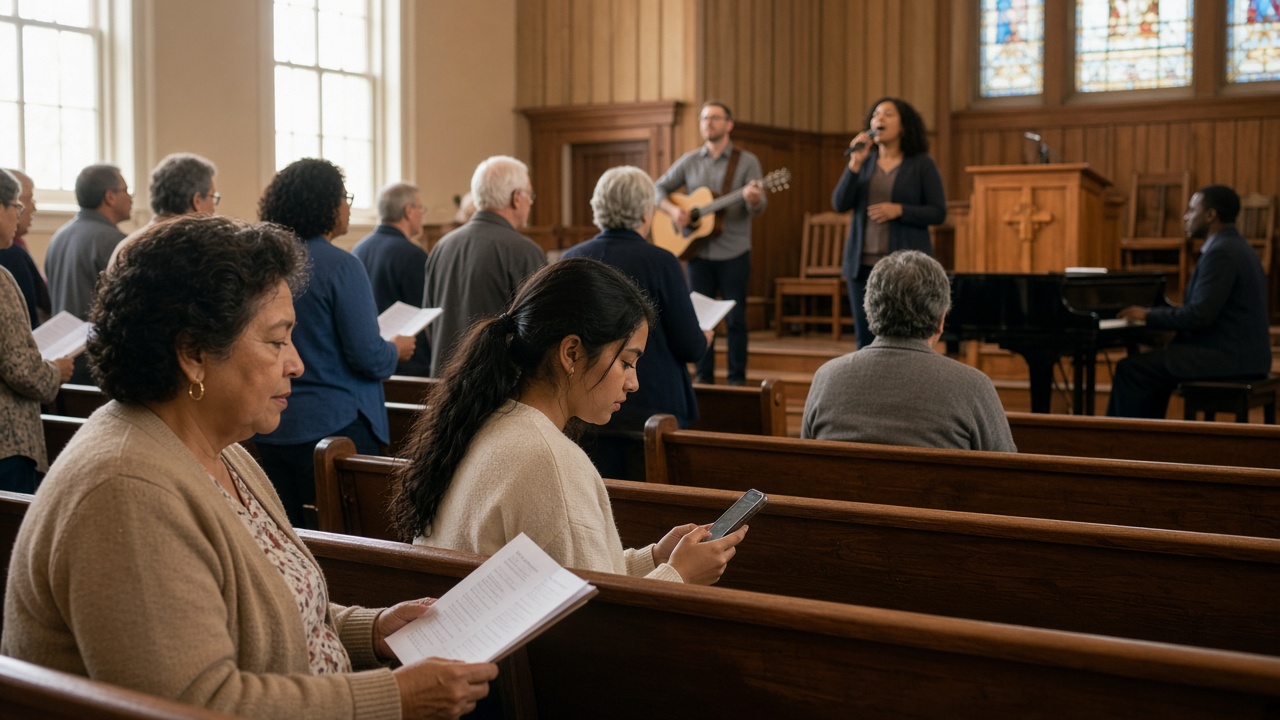
The worship leader is on a handheld. Pads and acoustic guitar sit under the melody. The congregation sings a half-beat behind, or ahead, or in a different key. Someone hums. A child talks in the aisle. If the feed is the house mix, the model is being asked to transcribe a choir, a band, and a room.
Even a clean vocal send is still one person singing, often with stacked tracks or a click that leaks from in-ear monitors. Congregational singing is the harder case: many mouths, no single onset, no single pitch. Human ears treat that as worship. A speech model treats it as overlapping talkers—the same failure mode that shows up in noisy panels.
This is not a Hope Translator quirk. It is how live speech systems work. Tools that claim to “translate the songs” are usually guessing at fragments or passing the music through untranslated. Both can be honest in different ways. Pretending a garbled caption is a bilingual hymn is not.
Lyrics are not sentences
Even when a line is heard, song text is a poor input for machine translation.
Spoken sermons mostly run in prose: subjects, verbs, a point that lands at the end of a paragraph. Lyrics compress. They invert grammar to hit a rhyme. They repeat a refrain that means more the third time because of the music under it. They carry theology in metaphor—“ocean,” “fire,” “veil”—that a translator of speech will render as ordinary nouns.
A human song translator works a different craft. They keep meter, singability, and the doctrine the original actually teaches. They choose whether a well-known hymn should appear in the version the room already sings. A live speech pipeline cannot do that work in a few seconds. It can only turn whatever text it captured into another language, without a melody to serve and without a hymnal to consult.
Two failures then stack. The transcript of the singing is already incomplete. The translation of that incomplete line is a second guess. The guest reads a caption that is neither the lyric nor the meaning, and concludes the whole overlay is untrustworthy.
A broken song feed teaches the wrong lesson
The cost is not only a messy phone during verse two.
Guests lose the sermon they were about to receive. If the first ten minutes of captions were nonsense, people put the phone away before the message starts. The overlay that would have helped them follow the preaching never gets a fair minute.
Staff decide the product failed. A Sunday demo that includes the full set is a harsh test of the wrong feature. The fair test is the spoken hour: welcome, Scripture, sermon, announcements, invitation. Judge those. If they are followable, the tool did its job.
The church keeps asking software to be a worship team. Heart-language singing is ministry, not a caption setting. A congregation that sings in Spanish is a different model from an English hour with a phone overlay. That decision belongs in Spanish service vs live translation, not in a software trial.
What actually helps people sing in another language
Match the tool to the job.
Put the words on a page or a slide. Many hymns and modern songs already exist in Spanish, Korean, Portuguese, Mandarin, and other languages your room actually uses. A printed bilingual lyric, a projected second verse, or a bulletin insert does more for sung worship than a live guess. Christmas Eve is the extreme version of this—candlelight, overlapping voices, carols everyone almost knows. The same logic is in how to make Christmas Eve multilingual: sung liturgy wants a page.
Translate the songs you already know you will sing. The set list is not a surprise. If you have four songs on Sunday, someone can prepare published translations you already have rights to use—or a bilingual volunteer can check them—on Thursday. That is editorial work. It is not live speech.
Do not spend quota on a praise set. Hope Translator is built for spoken content. If your board can send a speech-only feed, the songs never reach the translator. If you are using a room mic or a full mix, stop translation when the singing starts and start it again when someone talks. The broadcast channel can stay open so the QR code does not change. You also avoid using hours on audio the model cannot use.
Say the plan out loud. Guests should not have to invent an explanation for a quiet phone during the third song. One sentence is enough: the overlay is for the spoken parts; the lyrics are on the screen and the sheet.
Use live translation for the hour that is spoken
The public hour is still worth making followable. People decide whether to return during the welcome, the reading, the message, and the next-step invite—not during a chorus they could not sing anyway.
Hope Translator is built for live transcription and translation of speech—on the web and in the mobile apps—with broadcast (one speaker, many listeners) and solo / conversation (one-to-one) modes. A greeter or tech volunteer can host. Guests join with a QR code or link, pick a language, and read captions or listen to an AI voice. They do not create an account.
That is the right tool for live sermon translation and for the scaffolding around it. It is the wrong tool for a hymn. Churches that keep those jobs separate get a cleaner demo, a more honest promise, and a guest who still has the phone out when the pastor starts to preach.
If you want to hear the difference, run a short trial on a recorded sermon and on a recorded praise set. Judge the sermon. Print the songs.
Ready to make the spoken hour followable? Start a session at hopetranslator.com or compare plans on pricing.