What Church Greeters Can Do When a Visitor Doesn't Speak English
A family walks in. The greeter smiles. “Welcome! First time?” The grandmother does not have those words. Someone points at the sanctuary doors. Kindness happened. Access did not.
The first person a guest meets is already making a language decision—whether the church planned one or not. This is a list of welcome-table options, and the moves that quietly other people, when the doorway and the pulpit do not share a language. It is not a setup tutorial.
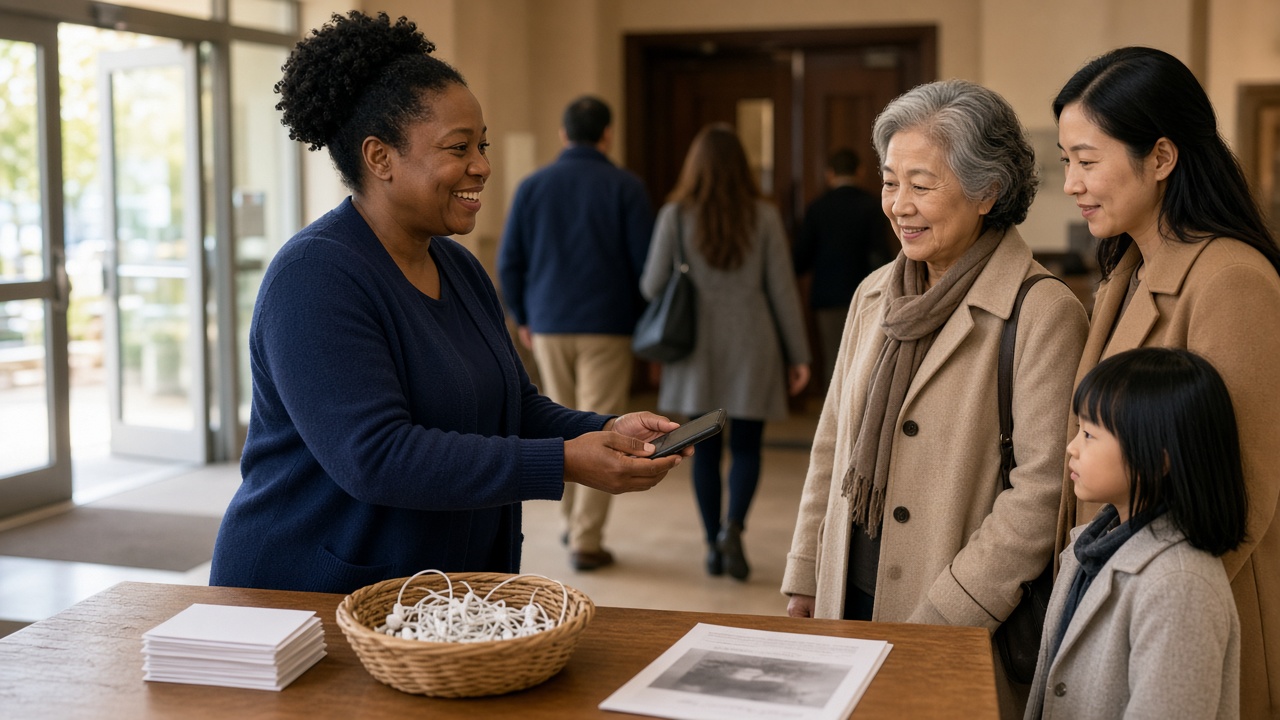
The doorway is already a language decision
Leaders measure welcome by the handshake. Guests measure it by whether the next hour will be silence.
The filter starts earlier than the door. An English-only visit page can stop a family on Saturday night—that is your church website as a language filter. The lobby is the first human version of the same question. If the greeter only has English, and the only plan is “find Maria,” the guest learns in thirty seconds that language help is a favor, not a system.
Picture an English-speaking suburban church—an example, not a customer story. The welcome team is warm. There is coffee. There is a “Bienvenidos” banner. There is no card, no spare earbuds, and no sentence from the platform that another language is allowed. A mixed-language family sits together. The teenager follows. The grandmother nods. They are not coming back because they could not follow the hour—see why church visitors don't come back. The greeter never meant that. The table still decided it.
1. Offer the same card to everyone
Do not profile.
Guessing someone’s language from their face, their name, or the way they hesitate at the bulletin is how you turn hospitality into an interview. Some guests who need another language look like they “speak English fine.” Some who look like they might need Spanish prefer English. Offer the same small card the way you offer a bulletin: translation is available, here is how, you do not have to announce yourself as a problem.
The sentence at the door can be short. “If another language helps, this card opens it on your phone.” Then stop talking. A greeter who launches into an explanation of software is already making the guest a project.
What fails is the public version of the same instinct: “Anyone who needs translation, raise your hand.” People who already feel like an interruption will smile and say they are fine. They are not coming back to ask again.
2. Put neighborhood languages on a small card, not in a speech
A printed card is not live translation. It is a map.
The useful card has four lines a guest can use before the prelude: a greeting in the languages you actually meet, how long the gathering usually runs, where children go, and how to follow the spoken hour. Have someone who uses that language write it or check it. Browser-translate is a draft, not a welcome.
The card must not promise a Sunday the church does not keep. “We translate the sermon live” is a promise. “We are a multilingual church” is a slogan, and it collapses if kids check-in, announcements, and the hallway are still English-only.
Keep the stack small and current. A faded Spanish card from 2019 and nothing in Korean tells the room which households you expected.
3. Treat the QR code like a bulletin, not an interview
If the hour can be followed on a phone, the join path has to feel as ordinary as a hymnal.
A QR code on the welcome table, on a pew card, and on the pre-service screen is one invitation, repeated. Guests scan with the camera they already use, pick a language, and read or listen. They should not need an account, an app, or a greeter standing over their shoulder unless they ask. The mechanics are in how to share live translation with a QR code. The hospitality question is whether anyone can find it without becoming a spectacle.
Sit with someone for the first scan if they want help. Do not escort them to “the Spanish section.” Mixed households came to sit together. If the lyric slide replaces the code four minutes in, the grandmother who arrived during the second song never saw that another language was allowed.
4. Keep loaner earbuds—and one spare charged phone
A card without a way to listen is a paper sermon.
Many guests already carry earbuds. Many do not. A basket of inexpensive wired earbuds is the difference between “we have translation” and “you can actually hear it.” Church-specific headset choices are in the wired headphones guide for sermon translation. At the table you only need them charged, clean, and findable.
Keep one spare phone or tablet already open to the join page. Dead batteries and guests who will not use their own data are the first-time visit, not an edge case. Do not make the loaner the bilingual volunteer’s personal device. When that person is in children’s ministry, it leaves with them.
5. Ask the platform to say one sentence so the door is not a secret
The greeter should not be the only person allowed to mention translation.
One sentence from the platform—early, once, without a joke—tells the room that another language is permitted. “If another language helps you follow, the card at the door opens live captions and audio on your phone.” People who slipped past the table now have permission. People who were afraid to look different now have cover.
This is a named Sunday line, not something the greeter invents on the fly. Who owns that sentence versus who starts the session is who should own live translation at your church. At the table you only need to know that a silent pulpit makes the doorway feel like a special request.
6. Walk them to kids check-in; do not only point
Parents decide the visit for the whole household.
Pointing down a hallway of English signs is how a family loses ten minutes and their nerve. Walk them. If children’s ministry is English-only, say so before they check in—not after a child is already in a room they cannot follow. That hallway is its own first-Sunday filter: English-only children’s ministry.
A parent who cannot read the pickup instructions will not relax during the sermon, even if captions are running in the pew. The welcome table does not have to staff kids church. It does have to refuse to pretend the sanctuary overlay covers the classroom.
7. Plan a human after the blessing who is not also the interpreter
Live translation can carry a sermon. It cannot shake a hand.
Someone still needs to say, after the hour, that the guest was not a problem to be processed. That person should not be the same body who just interpreted forty minutes, ran the laptop, and covered the door. Fluency is for presence: a name, a next-step table, a hallway question. High-stakes pastoral conversations still need a qualified human, not a phone between a pastor and a confession.
A lobby question—“where is the newcomer lunch?”—is a different mode from the sanctuary feed. Church life after the benediction is the longer problem in when only the sermon is translated. The table’s job is narrower: do not spend the only bilingual volunteer before the prelude.
Moves that quietly other people
These are common. They are also why a warm lobby still loses the guest.
Guessing the language. Offer the card. Let them choose. Nationality is not a caption setting.
Asking them to stand, wave, or introduce themselves in the other language. A first-time guest cannot easily say no from the aisle.
A banner without a followable hour. “Bienvenidos” on the wall and English in the pulpit is a sign, not a sermon.
“Let us know if you need translation.” That puts the work on the person who already feels like an interruption.
Handing the child the job. A bilingual child should not spend Sunday whispering the sermon for a parent. It isolates both of them, and it is not a language ministry.
Promising a second-language church you do not have. Overlay translation lets mixed households stay in one pew. It is not the same as a congregation that prays, sings, and is shepherded in that language. If that is the real decision, start with Spanish service vs live translation.
Where live translation fits—and where the table still matters
Live translation is the overlay that makes the hour you already run followable when one person is speaking. It does not greet anyone. It does not find the children’s hallway. It does not replace the human who talks to the family after the blessing.
Hope Translator is built for live transcription and translation of speech—on the web and in the mobile apps—with broadcast (one speaker, many listeners) and solo / conversation (one-to-one) modes. A greeter does not have to host. Guests scan a QR code or open a link, pick a language, and read captions, listen to an AI voice, or both. They do not create an account.
That is why the table is the missing piece in churches that already “turned translation on” from the booth. The feed can be clean and the grandmother still never looks up. Cards, earbuds, one platform sentence, and a walk to check-in are how an overlay becomes hospitality. For the sermon-side workflow, see church live translation for sermons.
Cost is not the main argument at the door, but it is why churches delay the overlay the greeter is trying to explain. Published ranges for a human interpreter are $50–$200+ per hour, per language. Hope Translator’s published entry benchmark is $20/month for 5 hours. Confirm current tiers on pricing. A plan will not make a guest feel known. It can keep the first person they meet from having nothing to offer except a smile.
Brief the welcome team on the card this week. Then start a session at hopetranslator.com and walk the lobby as a guest who does not speak the pulpit language.