English-Only Children's Ministry Is a First-Sunday Filter
A family stands at the kids check-in table. The greeter is kind. Name tags print. Someone points toward a classroom. From the sanctuary, this looks like hospitality working: parents will hear the sermon, children will hear a lesson, everyone has a place.
That is not how the family experiences the hallway.
If the child cannot follow the room, the visit is already over. Translating the pulpit does not rescue an hour the kids spent lost. Parents decide whether to return while they are still holding a sticker and a security label—not after the benediction.
This is a first-Sunday scenario, not a setup tutorial. The question is whether children's ministry is a second service with its own language wall.
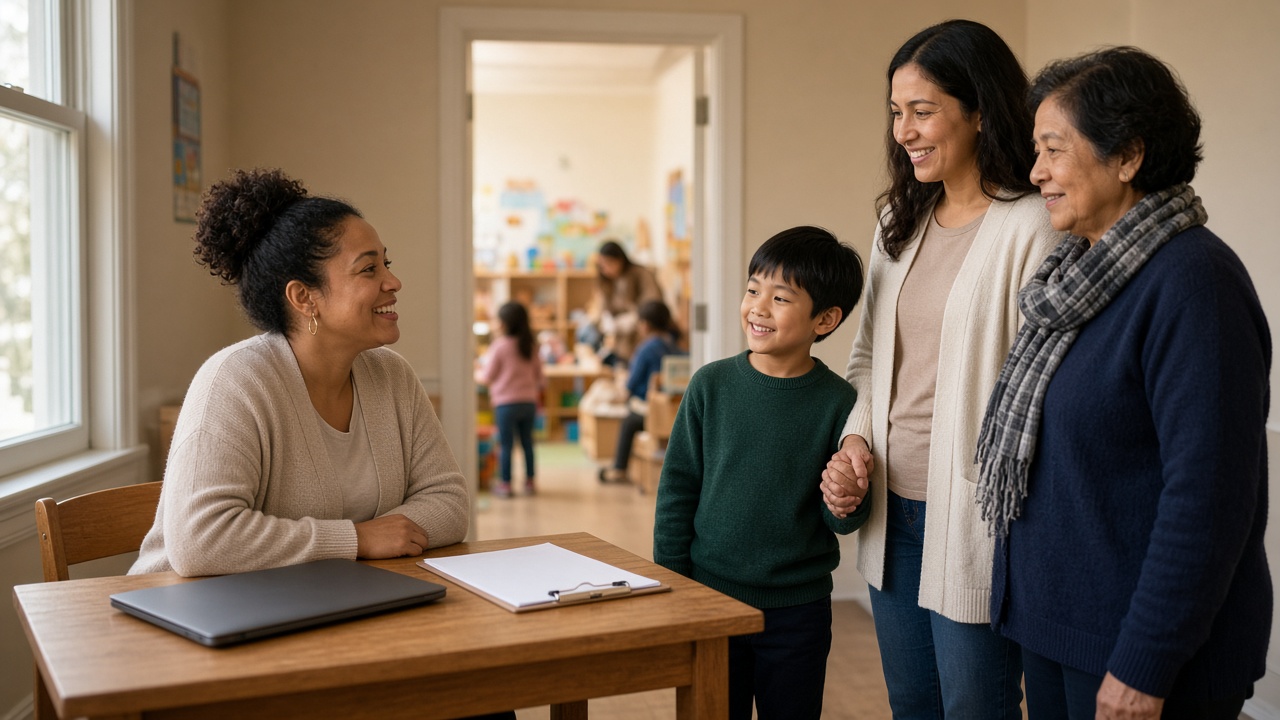
A hallway that looks fine from the platform
Picture an English-speaking church on an ordinary Sunday—an example, not a customer story. A mother thinks in Spanish. Her son is seven and newer to English than school has made him look. Grandmother came along because this was the week someone invited them. The church already plans to translate the sermon. The parents could follow the hour. The child is being asked to follow a different hour, in a different room, with different adults, in a language he does not think in.
Check-in is brisk. The clipboard is in English. The volunteer asks which grade, whether he has allergies, and whether a parent will stay for the first ten minutes. The mother smiles and guesses. The boy hears his name said once and a string of words he cannot use. He looks at the doorway. The classroom is already singing.
Forty-five minutes later the parents have a message they can discuss. The boy has a craft he cannot explain. In the car, the adults talk about the sermon. The child is quiet. That silence is the review.
First-time guests who cannot follow the sanctuary hour rarely come back. Mixed-language families add a second test: could the child follow the room we sent them to? Fail that test and the translated pulpit does not matter. The family will look for a church where nobody has to sit through a language they cannot use—including the child.
Kids church is not a waiting room
Leaders often treat children's ministry as logistics. It is the place kids go so adults can worship. Language planning follows that picture. The sermon gets the interpreter, the overlay, or the second service. The kids wing gets a curriculum in the language of the staff who already volunteer.
Children do not experience it as logistics. For them, that classroom is church. The songs, the story, the “Jesus loves you,” and the teacher who knows their name are the whole visit. If those things happen in a language they cannot follow, the building was friendly and the hour was not.
Parents experience it as a safety and belonging test. They are handing a child to strangers. They need to know the child will be safe, found at pickup, and not stranded in a room they cannot understand. A parent who can shop in English may still fail that test when the instructions are fast, the forms are dense, and nobody can explain the first-Sunday rule in the language the parent thinks in.
This is why an English-only kids wing can filter a neighborhood even when the sanctuary is becoming multilingual. The languages around the building already include children. Sunday school is often the last room anyone translates.
“Kids pick up English faster” is not a first-Sunday plan
Churches reach for this sentence because it is sometimes true later. It is a weak plan for week one.
Some children are new. A seven-year-old who arrived last year, or who speaks another language at home and English only at recess, cannot reconstruct a Bible story at classroom speed. Visuals help. They do not replace a language the child can think in.
Households are mixed. One sibling follows English. A cousin does not. A visiting grandmother cannot help at pickup because she never heard the dismissal instructions. The family did not come as one language profile. Kids church treated them as one.
Parents grade the child’s hour, not your intent. “They’ll catch on” is a six-month discipleship hope. The return decision is made before lunch. A child who was scared, bored, or silent is a reason to try a different church—even if the sermon was excellent.
Do not make the child the interpreter. Asking an English-fluent kid to explain the lesson to a parent, or to stay in the sanctuary to whisper, is a different failure. It uses the child as staff. It also answers the wrong question. The question here is whether the child’s room is followable, not whether the child can carry the adults.
English acquisition can be a gift of a church over time. It is not hospitality on Sunday one.
The rooms that fail before the lesson starts
The language wall is not only the Bible story.
Check-in. Spoken questions, printed forms, allergy lists, and the “first-time family” speech. If the parent cannot follow those sentences, they cannot honestly consent to the handoff. The volunteer may think they were clear. The parent may have nodded to end the line.
The doorway. A child hears a room already in motion: a song, a game, a teacher talking to the group. Entering a loud room in a second language is harder than sitting in a pew with a parent. Some children freeze. Some cling. Some go in and shut down. From the hall, it can look like shyness.
Preschool. Motion, music, and one adult voice over ten other voices. This is a poor room for any speech tool and a poor room for a child who does not share the language. What helps is a person, a visual routine, and a few phrases in the child’s language—not a laptop aimed at the snack table.
Elementary teaching. A ten-minute story with one teacher can be followable if the child can hear it in a language they use. A rotation of crafts, videos, and overlapping instructions cannot. If you only “translate kids church” in the abstract, you will aim at the wrong ten minutes.
Pickup. “Today we learned about Moses. Next week bring a coat for the park day.” That sentence is how parents decide the church remembered their child. If it is only in English, the family leaves with a craft and no map.
None of this requires a cold volunteer. It only requires a kids ministry designed as if every child already belongs to the language of the classroom.
What actually helps a family consider Sunday two
You do not need a second children’s campus next month. You need the first visit to be honest and followable.
Name the language of the room. If kids church is English, say so on the website, at the welcome desk, and at check-in—in the languages families actually speak. A surprise English classroom after a multilingual promise in the lobby feels like bait. Clarity is kinder than a translated banner over an English-only hour.
Put a bilingual presence at the table when you can. One person who can do the check-in conversation in Spanish, Korean, or Portuguese changes the handoff. That person should not also be expected to interpret the sanctuary, teach the class, and cover pickup. The volunteer-burnout pattern starts in this hallway as easily as it starts in the booth.
Teach the story so more than one language can enter. Picture schedules, gestures, and a few key phrases on the wall help every child, including English speakers. Lifeway’s kids-ministry guidance for multi-language rooms is practical here: learn how the child communicates, put the routine where they can see it, and do not assume the printed English curriculum is enough. That is classroom craft. It is not a sermon overlay.
Decide whether you are planting a language class or overlaying the one you have. A Spanish elementary hour with a Spanish-speaking teacher is a small version of a second-language service. It shepherds in that language. It also splits siblings and needs a teacher who will still be there in February. An overlay keeps mixed rooms together and covers more than one language in the same lesson. Neither is a consolation prize. They solve different rooms.
Talk to the parent in a language they can use. Pickup, the first-Sunday stay-and-see rule, and the “your child had a hard morning” conversation are pastoral moments. They are also the moments families remember. If the only Spanish in the building is a sermon QR code, the kids wing still feels English.
Summer intensifies the same problem. Vacation Bible School is a week of classrooms, assemblies, and pickup lines. Friday youth group is the older version of the same filter. If those hours are followable and Sunday kids church is not, families notice the inconsistency.
Where live translation fits—and where it does not
Live translation is the overlay that makes a spoken hour followable. It is not a preschool, and it is not a person.
Hope Translator is built for live transcription and translation of speech—on the web and in the mobile apps—with broadcast (one speaker, many listeners) and solo / conversation (one-to-one) modes. A teacher or greeter can host. Families scan a QR code or open a link, pick a language, and read captions, listen to an AI voice, or both. They do not create an account.
That is the right tool when one adult is teaching and older children or parents can follow on a phone or a shared screen: a preteen lesson, a kids-church welcome talk, a parent meeting in the fellowship hall. It is also the right tool in the sanctuary, so the adults who just dropped off a child can follow the sermon instead of sitting through silence and wondering how the classroom is going.
It is the wrong tool for a singing preschool, a craft table with five voices, or a child who cannot yet read captions. Young voices, songs, and room noise are hard for any speech recognizer. Do not put a broadcast QR on a snack counter and call the classroom multilingual. Translate the spoken lesson when the room can actually feed one clear voice. Use a human for the doorway.
Use a qualified interpreter for counseling, a child-safety conversation, or any talk where a misunderstanding is not acceptable. Live translation is not a certified interpreter and not a background check.
Cost is not the main argument here, but it is why churches translate the pulpit and stop. Published ranges for a human interpreter are $50–$200+ per hour, per language, often with 2–4 hour minimums. Hope Translator’s published entry benchmark is $20/month for 5 hours. Confirm current tiers on pricing. A plan will not make a seven-year-old feel known. It can keep the spoken parts of Sunday—including the parent hour—from being the reason the family never comes back.
A kids-wing test for leaders
Before you buy anything, walk last Sunday as a family that does not share the classroom language.
- Could a parent complete check-in without guessing?
- Could a child who is new to English follow the actual lesson, not only the game?
- Could pickup explain one next step in a language the parent thinks in?
- If your bilingual volunteer was in the sanctuary, what happened at the table?
- Did the website tell the truth about the language of kids church?
If the honest answers are no, the problem is not that your children’s team is unfriendly. The problem is that hospitality ends at the sticker printer. Fix the rooms the family actually used. Then keep doing the human work software cannot do: learn the child’s name, say one sentence in their language, and—if a language community is forming—ask whether a class in that language is the next calling, not a substitute for this Sunday.
Ready to make the spoken hour followable for the adults who just trusted you with their kids? Start a session at hopetranslator.com or compare plans on pricing.