Who Should Own Live Translation at Your Church?
The elders approved the software. Someone forwarded the login to the sound booth. On the first Sunday the laptop was open, three people scanned the QR code, and the board concluded that translation does not work here.
The tool was not the failure. Ownership was. Live translation is not one Sunday job. It is an audio job, a hospitality job, and a pastoral decision. Churches that assign all three to whoever already owns the mixer—or whoever happens to be bilingual—get a followable sermon that nobody is invited into, or a stack of cards that captions garbage.
This is a staffing and ministry-design question, not a setup tutorial. If you are still deciding whether a hire can carry the whole language plan, start with A Bilingual Hire Is Not a Church Language Strategy. The question here is narrower: once the public hour should be followable, whose name is on Sunday?
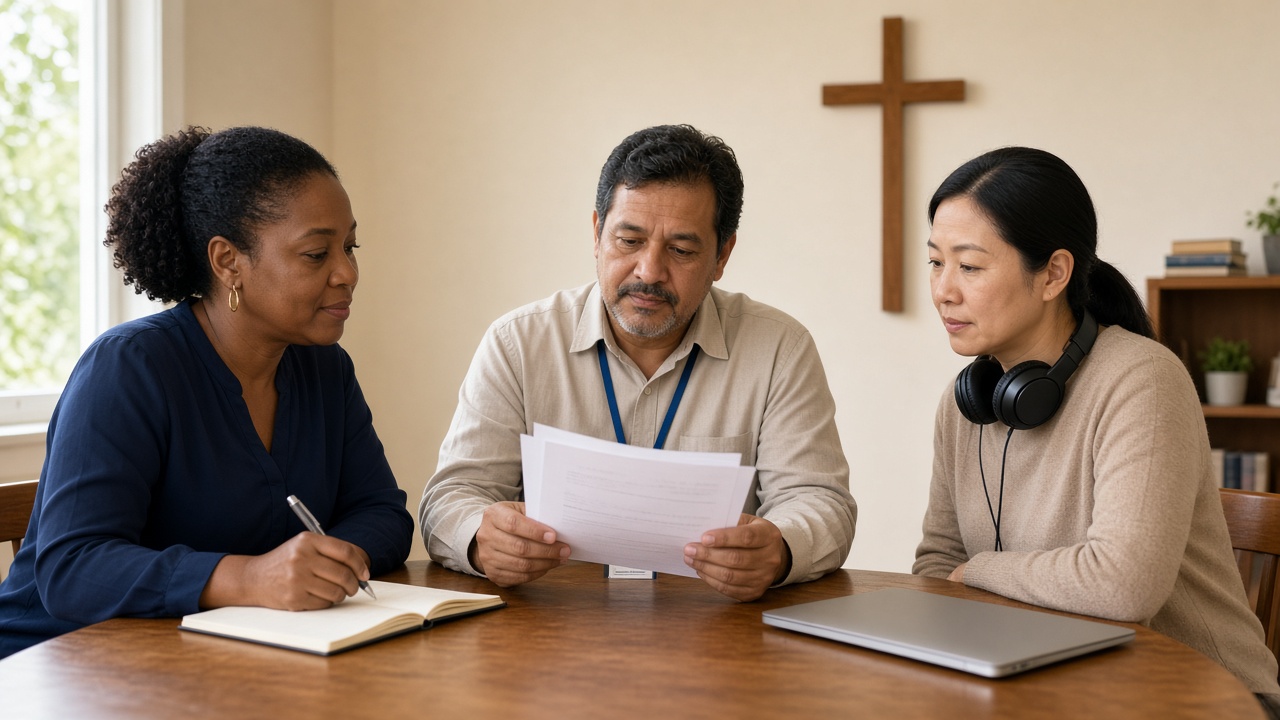
The sound booth owns audio. It does not own the guest.
AV ownership is the default because the laptop lives near the mixer.
That is a reasonable first assignment. Captions are only as good as the speech they hear. A mix-minus or speech-only feed, a session that actually starts, and someone who notices when the transcript freezes—those are booth jobs. If you are still routing pulpit audio into a laptop, how to connect a sound mixer is the technical layer of this work.
What the booth cannot see is the rest of the visit.
Picture an English-speaking suburban church—an example, not a customer story. The operator starts the session during the welcome slide. The feed is clean. Spanish and Korean are available. From the booth, language is “on.” In the lobby, a grandmother never looks up at the screen. The lyric slide replaces the QR code four minutes in. A family that would have used translation sits through silence because nobody handed them a card, and nobody said from the platform that another language was allowed.
A clean feed is necessary. It is not an invitation. First-time guests who cannot follow the hour rarely come back. They also do not come back when the hour was followable in theory and invisible in practice.
If the only owner is AV, you will get a technically successful overlay and a hospitality failure that looks like “nobody wanted it.”
Hospitality can fill the pew and still miss the hour
Give the welcome team the cards and they will offer them. That is the right instinct.
Hospitality owns the last few feet: a printed QR, a basket of wired earbuds, one sentence a greeter can say without turning the doorway into an interview. Helping someone scan without making it a spectacle is pastoral work that happens at a table, not in a booth. The artifact itself is how to share live translation with a QR code.
What hospitality cannot do from the door is hear whether the pulpit microphone is the input. They cannot restart a session that died during the second point. They cannot decide whether this is every Sunday or Easter only. They should not be asked to become the interpreter because they were the ones holding the cards.
If the only owner is the welcome team, you will get a lobby that looks multilingual and a sanctuary whose captions are guessing at room noise.
The pastor cannot own it from the pulpit
Pastoral ownership is the right decision layer. Cadence, budget, and what you promise guests are elder and pastor work. So is the one sentence from the platform: translation is available, here is how, you do not have to announce yourself as a problem to use it.
The pastor who “owns translation” without naming an operator has a vision, not a ministry. They cannot start the session, greet at the door, and preach. If the login lives in their inbox, Sunday depends on whether they remembered to forward it before the prelude.
Pastors also should not become the bilingual fallback. Preaching and interpreting are different jobs, and fusing them is how you lose both worship and access. The unpaid version of that fusion already has a name: why church volunteer interpreters burn out. Putting the pastor’s name on the same design does not redeem it.
Three Sunday jobs that cannot share one body
Churches do not need a six-person department. They do need to stop asking one body to be in two places at 10:02.
The operator sits with the audio path. They start the broadcast, confirm that speech is reaching the session, and stay close enough to notice a freeze. They do not have to be bilingual. They have to be present at the desk.
The inviter stands where guests actually look: a door, a welcome table, a pew card. They offer the code the way they offer a bulletin. They can sit with someone for the first scan. They are not monitoring the mixer.
The coordinator does not have to be in the building at 10:00. They own decision rights during the week: which languages you are prepared to support, whether this is a standing promise, who covers vacation, and what happens when a phone will not scan. In a small church this can be an elder or an administrator. It should be a named person, not “the staff.”
The failure is not combining coordinator with operator in a church of eighty. The failure is combining operator with inviter on the same morning, or combining either with the person in the pulpit. One volunteer cannot restart a dead session and walk a family through a first scan at the same time.
Do not solve the split by handing all three jobs to the bilingual member. That is the hire-as-booth problem with a volunteer badge. Fluency is for presence after the blessing—prayer, a next-step conversation, a name remembered. It is not a requirement for starting a laptop.
A simple ownership map
In a smaller church, keep the chart short. Name a coordinator who is not preaching. Name one Sunday operator and one backup. Brief every greeter with the same sentence and the same card. The preacher’s only live job is that sentence from the platform, plus finishing thoughts so speech translation has sentences to work with.
In a midsize church, put the coordinator on staff if you can—not because they must speak every language, but because someone has to keep the promise when volunteers rotate. AV owns the feed and the session. First impressions owns cards, help, and loaner earbuds. The pastor owns cadence and the public invitation. Kids check-in is a separate door; do not assume sanctuary translation covers the classroom.
In any size, write down what happens when the operator is out. If access disappears when one person has the flu, you do not have a language ministry. You have a person you have not yet lost.
The overlay for the public hour is live sermon translation: one speaker, listeners choosing a language. Ownership is what keeps that overlay from becoming a forgotten login in the booth.
Where live translation fits
Live translation is the system that makes the hour you already run followable without parking it on one interpreter’s calendar. It does not replace bilingual pastoral care. It does not decide whether you should plant a second-language congregation. It answers a narrower question: can a guest follow what is being said, this Sunday, without you knowing their language in advance?
Hope Translator is built for live transcription and translation of speech—on the web and in the mobile apps—with broadcast (one speaker, many listeners) and solo / conversation (one-to-one) modes. A greeter or tech volunteer can host. People scan a QR code or open a link, pick a language, and read captions, listen to an AI voice, or both. They do not create an account.
That lowers the skill required at the desk. It does not remove the desk, or the door. The churches that keep it week after week are not the ones with the most bilingual staff. They are the ones who named an operator, briefed the greeters, and let the pastor stay in the pulpit.
Compare current plans on pricing, or start a session at hopetranslator.com and run it on a talk you already give—then decide who will own each of those three jobs before next Sunday.