What Conference Attendees Still Miss When Only the Keynote Is Translated
The keynote looks multilingual. Headsets are on the front rows. A caption board sits beside the slides. The opening speaker lands, the room applauds, and the production team marks language as done.
Then the day starts.
Attendees file into breakouts, ask questions, hunt for Room 3B, stand at a booth, and try to join a lunch table. Those hours are why most people bought a ticket. If only the main stage was translated, the conference they paid for is still in one language.
This is a list of attendee moments, not a setup tutorial. The question is whether language access covers the event people actually attend.
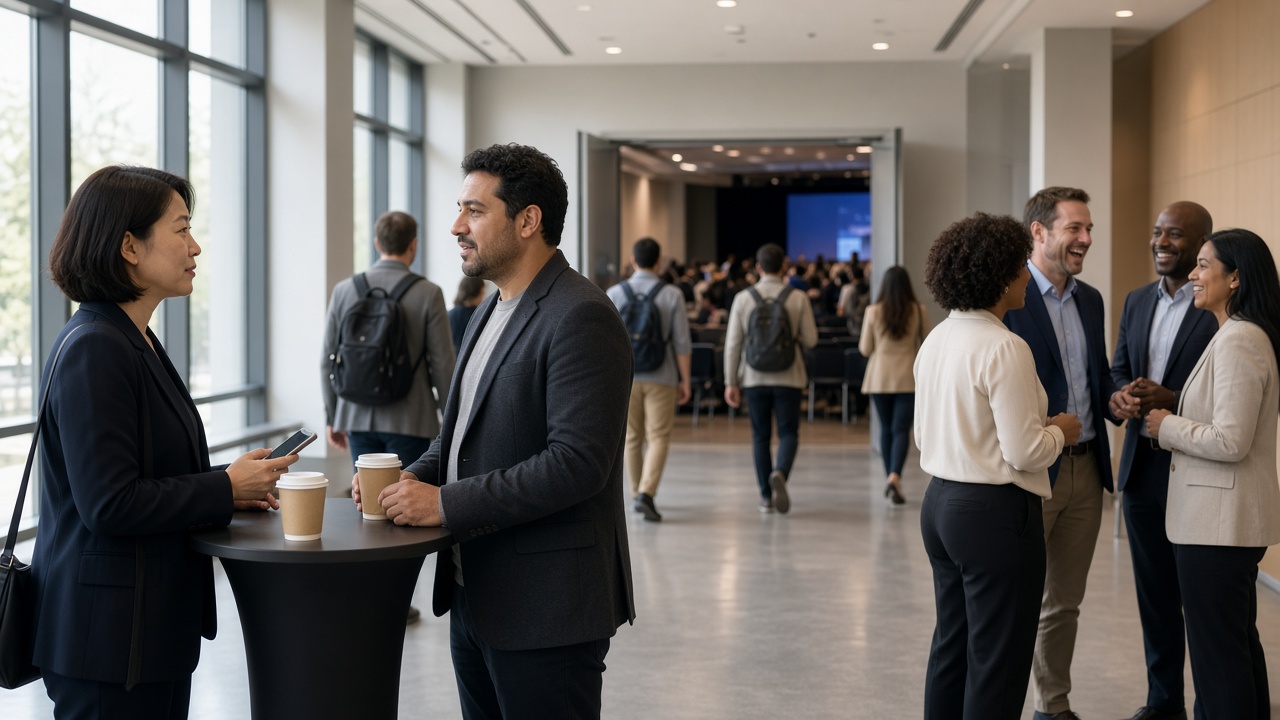
1. Check-in is the first session
A conference begins at the badge table, not at the lectern.
Picture a two-day regional summit—an example, not a customer story. A sponsor arrived early. The volunteer asks which track, whether they need the dinner add-on, and whether the badge printer has their name. All of that is spoken, fast, and in the floor language. A translated keynote at 9:15 does not help a person who already guessed their way through registration at 8:20.
Wayfinding is the same job in a hallway. “Overflow is in the junior ballroom.” “Your session moved.” Those sentences decide whether someone reaches a room they can use. Printed maps help when they exist in the right language. Most of the confusion is a person pointing and talking.
What helps is not a second keynote interpreter at the door. It is a welcome desk that can hand a card, and a one-to-one tool for the conversation that does not belong on a room-wide feed. If the only translated sentence all morning is the emcee’s welcome, check-in already told multilingual attendees they are guests of an English event.
2. Breakouts are the conference
The keynote is one hour. The agenda is six.
Workshops, roundtables, and track sessions are where attendees came to do work: a method, a case, a tool they can take home. Organizers still staff language for the room with the most cameras. The smaller rooms stay in the floor language because “those are more informal,” or because nobody booked a booth for fourteen simultaneous sessions.
Informal is not the same as optional. A person who followed the opening keynote in their language and then sat through three English-only workshops did not attend a multilingual conference. They attended a translated speech and a monolingual training day.
You will not put a human booth in every breakout. That is the point. A live overlay on a clear speaker feed can travel with the rooms you already run. One host session per room, listeners picking a language, no attendee account. The constraint is audio, not furniture: one person at a microphone, not five voices over a coffee urn.
For the wider event model, start with live event translation. The decision here is narrower: did you fund the hour people came to learn, or only the hour you livestreamed?
3. Q&A is where people stop being an audience
Panels and floor questions are the first moment attendees are asked to speak.
That is also the moment most language plans collapse. Two panelists talk over each other. A question comes from a hallway mic that nobody sound-checked. The moderator summarizes in the floor language and moves on. Anyone following a translation of the keynote feed hears a blur, or hears nothing, because the extra mics were never in the session.
Participation is the product. People travel to ask a question, not only to hear a talk. A 2025 CHI study of live Q&A at English-language academic conferences found that non-native English-speaking presenters already struggle to catch fast, overlapping speech in real time. Attendees on the other side of that exchange have the same problem without a podium.
What helps is operational: one microphone, a repeat of each question, and the same translation channel on the panel as on the keynote. What does not help is promising “live translation for the program” and switching it off when the interesting part starts.
4. The expo floor is a spoken marketplace
Sponsors did not pay for a seat at the keynote. They paid for conversations.
A booth demo, a product walkthrough, a “what does your team actually need?”—those are one-to-one or one-to-few talks in a loud hall. A room-wide broadcast of the keynote hall does not reach them. A bilingual intern at two booths does not cover a floor.
This is where organizers confuse two jobs. Captions in the keynote language help people who can hear or read that language. They do not turn a booth pitch into Spanish or Korean. A human interpreter is the right call for a booked partner meeting. For walk-up traffic, a booth staffer needs something they can start without a work order.
Hope Translator’s solo / conversation mode is built for that one-to-one pattern. Broadcast stays on the rooms with one speaker and many listeners. Do not aim a keynote QR at a carpeted aisle and call the expo multilingual.
5. Lunch is the networking session you already scheduled
The agenda says “networking lunch.” The language plan says nothing.
Hallway introductions, table talk, and the line at coffee are how attendees decide whether they met anyone. For people who share the floor language, that hour is the point of coming in person. For everyone else it is a cafeteria they cannot join. They can nod. They cannot trade a card and a next step.
You will not translate a dining room. You can stop pretending the keynote solved hospitality. Brief a few hosts to sit with people who are scanning the room. Offer a one-to-one tool for the introduction that matters. Put the same access card on the café table that you put on the theater seat.
A conference that translates the speech and leaves the meal in one language has hosted a lecture, not a gathering.
6. The announcement of translation is often only in one language
Language access that nobody can find is a production credit, not a service.
If the only explanation is an English slide at 8:55, or a sentence in the emcee’s opening that multilingual attendees cannot follow, you announced translation to the people who did not need it. The people who needed it were still at check-in, or already lost.
Treat discovery like wayfinding. A card at badge pickup. A line on the confirmation email in the languages you actually expect. A greeter who can show a QR code on their own phone. A mention from the stage and a card in the seat. Attendees should not have to raise a hand and identify themselves as a language problem.
Once people leave the keynote hall, personal phones usually beat a front-of-room caption board. Each listener controls language, text or audio, and brightness. A shared screen still helps when most of a breakout needs the same language as text. The longer framework is presentation screen vs personal devices.
7. “What’s next?” is a second keynote
The last plenary is short and dense. Tomorrow’s track changed. Evaluations close at 5:00. The community link is this QR. Speakers will be in the hallway.
Those minutes are how an attendee turns a trip into a follow-up. If they only understood the opening keynote, they leave with a notebook and no map.
Be honest about the split. Live translation can carry the spoken close. It will not localize your event app or your slide deck. Budget print and UI translation for the materials people have to act on. Budget a live overlay for the sentences you say into a microphone. Mixing those up is how teams buy a speech tool and wonder why the registration form is still English-only.
What these gaps are not
They are not an argument that every hallway needs a booth. Human interpreters remain the right call for legal, medical, or diplomatic sessions, and for any conversation where a misunderstanding is not acceptable. If you are weighing a human voice against an overlay for a given hour, start with live translation vs a human interpreter.
They are also not a vendor checklist. Feature lists belong in real-time translation tools for conferences. This list is the attendee day. If a tool only covers the room with lighting, it will look excellent in the show recording and fail in Room 3B.
Where live translation fits after the keynote
Live translation is the overlay that makes a spoken hour followable. It is not signage, and it is not a networking host.
Hope Translator is built for live transcription and translation of speech—on the web and in the mobile apps—with broadcast (one speaker, many listeners) and solo / conversation (one-to-one) modes. A stage manager or volunteer can host. Attendees scan a QR code or open a link, pick a language, and read captions, listen to an AI voice, or both. They do not create an account.
That is the right tool when the people who need another language are already in a room you are running—or walking up to a booth. Use broadcast for keynotes, breakouts, and panels with one clear feed. Use conversation mode for the welcome desk, the expo question, and the hallway introduction. Use a qualified human for the sessions your counsel would not run through a caption overlay.
Cost is why teams translate one room and stop. Published ranges for a human interpreter are $50–$200+ per hour, per language, often with 2–4 hour minimums. A second breakout language is a second invoice. Hope Translator’s published entry benchmark is $20/month for 5 hours. Confirm current tiers on pricing. Five spoken hours will not cover a three-track summit; larger days need a larger published plan. The point is that access should survive the keynote.
If you are choosing a tool, ask whether attendees can join without an account and whether more than one language can ride on the same session. Those tests matter more than another lighting cue on the main stage.
Close the day, not only the curtain
Walk last year’s agenda as an attendee who does not think in the floor language. Could they collect a badge without guessing? Could they follow the workshop they came for? Could they ask a question, understand a booth, and catch one next step?
If the honest answers stop at the keynote, you did not host a multilingual conference. You translated a speech. Put access on the hours people actually used. Then keep doing the human work software cannot do: sit with someone at lunch, introduce two people who should meet, and staff a person—not a feed—for the conversations that should never have been added to a caption overlay.
Ready to make the rest of the day followable? Start a session at hopetranslator.com or compare plans on pricing.