Guests Can Follow the Sermon and Still Miss Communion
The grandmother followed the sermon on her phone. Captions kept up. She could tell you the point. Then the pastor set a loaf on the table, said a few sentences without looking at the microphone, and the room stood. Trays started down the aisle. She did not know whether to take the bread, pass it, stay seated, or walk forward. Her granddaughter whispered one word and then had to take an element herself. The overlay that made the message followable had nothing left to say, because the pastor was no longer talking into it.
This is not a setup tutorial. It is the hospitality problem churches create when they treat live sermon translation as the whole spoken hour. Communion is still speech. It is also a set of instructions, a fence, and a pastoral invitation. If those stay in one language, the table is English even when the homily was not.
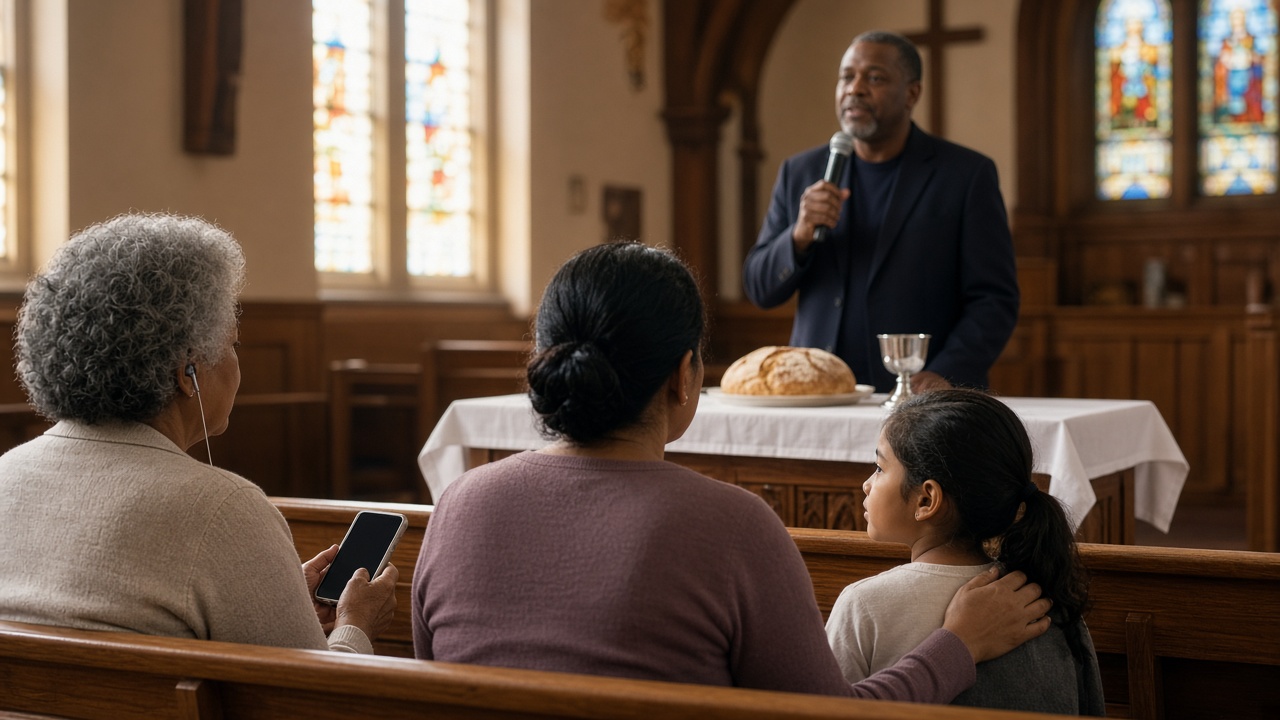
The sermon can succeed and the table still fail
Leaders measure language by the pulpit. If the message was followable, language is “handled.” That is a reasonable first test. First-time guests who cannot follow the hour rarely come back. Communion is a harder test because it asks people to do something, often in public, on the basis of words they may not have understood.
When only the sermon is translated, church life after the blessing stays in the pulpit language: small groups, serving, the class that makes members. The table is the same pattern still inside Sunday. The guest never left the pew. They still hit a wall.
Picture an English-speaking suburban church—an example, not a customer story. Spanish audio ran through the message. Korean captions ran for a visiting grandmother. Then the pastor moved from the lectern to a table, dropped into a quieter voice, and explained who should come, who should wait, how to receive, and what the gluten-free station is. The feed still heard the room. It did not hear a speech. Distribution music started. Phones filled with fragments. People who had followed the Word spent the most theologically loaded minutes of the hour guessing.
Hospitality guides written for churches that welcome international students often name this moment as the hardest one to make intelligible: not the sermon, the explanation of what is about to happen at the table. The guest is not asking for a second homily. They are asking whether they are allowed to participate, and how not to embarrass anyone if they are not.
What guests actually have to understand
Communion is not only a symbol they can watch. It is a set of decisions the room expects them to make in the next two minutes.
Whether they are invited. Open table, baptized members, confirmed communicants, “if you trust Christ”—traditions differ, and guests should not have to infer the fence from who stands up. A sentence that is pastoral in English is a locked door in another language.
How to receive. Come forward or stay seated. Take, dip, or wait for a tray. Eat now or hold the bread. Wine or juice. A cup on the table or a cup in the aisle. Churches change this from week to week and still announce it only once, in the floor language, while ushers are already moving.
What the elements are. Bread, wafer, gluten-free. Wine, juice. For someone new to church, or new to this church, those are not obvious. A mistranslated joke about “this is not a snack” is less damaging than silence that leaves a child eating and a parent unsure.
Where to go with a question. The rail, the side chapel, a prayer minister, “see me after.” If that invitation is English-only, the people who most need a person are the people who cannot parse the sentence.
None of this is a request that live translation become a sacramental theology. It is a request that the spoken instructions be as followable as the sermon that preceded them.
Why the explanation stays in one language
Churches skip this on purpose, and they skip it by habit.
They assume shared memory. Regulars already know the choreography. The pastor shortens the explanation because the room looks familiar. Guests and visiting family do not have that memory. Christmas Eve and baptism Sundays multiply the problem: the language mix is widest on the days the liturgy is least explained.
The microphone moves. The message was preached into a headset. The table is a handheld the pastor does not use, or uses only for the first sentence. Live speech translation cannot recover words the feed never heard. The same church that invested in a clean pulpit send treats the institution as a private aside to people who already belong.
Music covers the gap. Distribution is often a song. Live translation cannot follow worship songs, and it should not try. The failure is earlier: the spoken explanation ended, or never started, before the band filled the room. Guests then judge the overlay by the fragments on their phone during a hymn.
The words feel too holy to paraphrase. That instinct is pastoral. Fixed liturgical texts—the words of institution, a Eucharistic Prayer, a communion hymn—deserve a human translation a tradition already authorized, not a live guess at poetry. The mistake is treating every sentence at the table as untranslatable liturgy. “Gluten-free is at the left station” is not a canon. It is an instruction. Instructions can be spoken clearly, into a microphone, in sentences.
Spoken liturgy is not a hymn, and it is not a PDF
Two adjacent jobs get mixed up here.
Sung worship is a poor input for a speech translator: stretched vowels, stacked voices, rhyme that is not prose. Pause the overlay for the song. Put published lyrics on a page or a slide.
Communion speech is different. If the pastor is on a microphone, the pipeline that followed the sermon can follow the explanation, the reading, and the invitation. That is still live transcription and translation of talking. It will not match a hymnal line-for-line. It does not have to. It has to make the next two minutes intelligible.
Printed cards and slides are still the right tool for anything you want people to read together in a stable wording: a short explanation of the Lord’s Supper in Spanish, Korean, or Portuguese that a bilingual member has reviewed; an official liturgical text your tradition requires. Friends International’s hospitality notes for churches serving international students recommend exactly that kind of card. A live overlay does not replace it. A card does not replace the sentences the pastor will improvise this morning about stations, allergens, and who should remain seated.
Catholic, Orthodox, and other liturgical churches have a further constraint. Approved translations of the Mass or Divine Liturgy exist so the prayer the church prays is the prayer the church authorized. A phone overlay is not that authorization. It can still help a guest follow a spoken instruction, a homily, or a comment from the deacon. It should not be billed as a substitute missal.
What actually helps at the table
Match the tool to the minute.
Keep the microphone on through the explanation. The table is still public speech. If you moved from a headset to a handheld, finish the institution and the instructions before you set it down. If you always celebrate without amplification, a lav or a mic on a stand is the language ministry, not a production flourish.
Say who is invited in a complete sentence. “If you are not receiving today, you are welcome to stay seated” is clearer than a glance at the pews. Guests who cannot follow English need that sentence as much as the regulars who already know it. Repeat it when the room is mixed. Christmas Eve, weddings, and baptisms are mixed on purpose.
Do not spend the overlay on the distribution song. Stop translation when the singing starts, the same way you would for a praise set. Start it again if someone speaks. The QR code does not need to change. Guests should hear, once, that the phone is for the spoken parts.
Put a short card in the languages you actually meet. One paragraph: what this is, who is invited, how to receive, where the gluten-free station is. Review it with a native speaker. That is Thursday work. It is not a live-translation feature, and Hope Translator does not project announcement slides onto phones. The card and the overlay do different jobs: one is a stable text, the other is the pastor’s voice this morning.
Station a person, not a second caption, at the rail. Someone who wants prayer, or who does not know whether they should come, needs a human. Conversation mode on a phone can help a greeter through a hallway question. It is the wrong tool for counseling, confession, or any conversation your tradition treats as pastoral in a way that should not run through a caption overlay. Use a qualified interpreter for that. Use live conversation translation only for the practical question: where to stand, whether the juice is wine, how to pass the tray.
Where live translation fits
Live translation will not celebrate the sacrament. It will not decide your fence. It will not turn a sung Agnus Dei into a bilingual choir. It answers a narrower question: can a guest follow what is being said at the table, this Sunday, without already knowing the choreography?
Hope Translator is built for live transcription and translation of speech—on the web and in the mobile apps—with broadcast (one speaker, many listeners) and solo / conversation (one-to-one) modes. A tech volunteer can keep the same Sunday session running from the sermon into the explanation. Guests join with a QR code or link, pick a language, and read captions, listen to an AI voice, or both. They do not create an account.
That is the right tool for the spoken table. It is the wrong tool for the song under the distribution, and it is the wrong tool for a private conversation at the rail. Churches that keep those jobs separate get a guest who still has the phone out when the loaf is broken—and a prayer minister who is free to be a person.
If the hour is already followable through the homily, do not end the overlay when the preacher leaves the lectern. Run the explanation. Print the card. Then decide, as a church, what the table is asking of people who could not have guessed the instructions.
Ready to make the spoken hour—including the table—followable? Start a session at hopetranslator.com or compare plans on pricing.