If the Annual Meeting Is English-Only, Membership Is Too
Sunday can look multilingual. Captions run. A grandmother follows the sermon on her phone. The family stays in one pew. Then the church schedules the hour that actually names members: the budget, the slate of elders, the bylaws change, the call of a pastor. The packet is English. The moderator is English. The motion is read once, quickly, from the floor.
That is not an oversight in the AV rack. It is a membership decision. People who can follow the Word and cannot follow the vote are guests in the church they already joined.
This is not a setup tutorial for a board packet, and it is not a claim that software makes a vote legally valid. It is the gap churches create when live sermon translation stops at the pulpit and never reaches the congregational meeting.
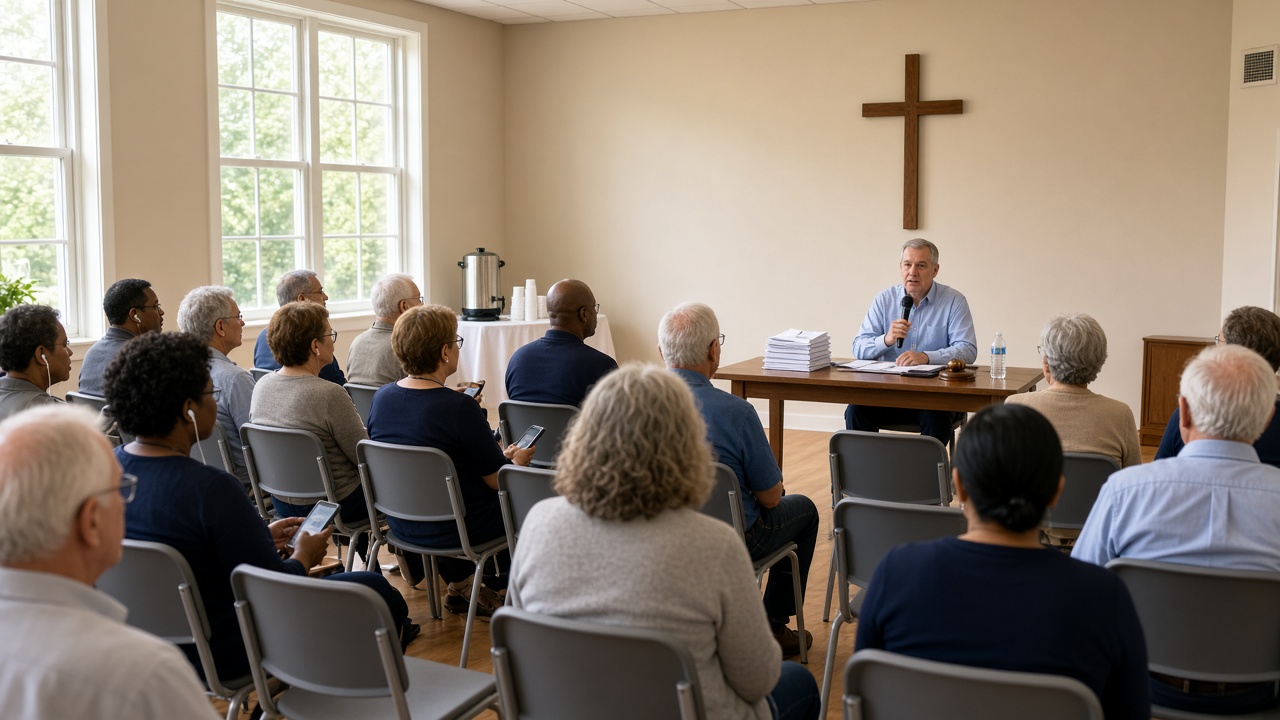
Sunday can be followable and the vote still is not
Leaders measure language by the public hour. If the homily is followable, language is “handled.” First-time guests who cannot follow that hour rarely come back. The annual meeting is a later, quieter test: whether the people you invited to belong may also govern.
Membership is not only a class and a handshake. In most congregations it is also a meeting with a quorum, a motion, and a show of hands. If that meeting only works in the pulpit language, the church has two memberships. One hears the sermon. The other writes the budget.
The gap is easy to miss because the room looks full of insiders. These are not first-time visitors hunting a parking space. They already found a pew. They already scanned a code. Then the clerk mailed a packet they cannot use, and the moderator assumed that anyone who survived Sunday can survive Robert’s Rules.
What this hour actually decides
Picture an English-speaking suburban church—an example, not a customer story. Spanish audio ran every Sunday for a year. Korean captions ran for a visiting grandmother who stayed. In January the church holds its annual meeting in the fellowship hall after a short worship set.
The docket is ordinary and heavy:
- A budget that changes staff hours and the missions line
- A slate of elders, deacons, or vestry members
- A bylaws amendment about who may vote, and from where
- A motion to call a pastor, sell a building, or plant a second site
None of that is a sermon. All of it is the church saying what it is. A member who cannot follow the debate can still raise a hand when the people around them raise theirs. That is not consent. It is courtesy dressed up as a vote.
This is a different job from a four-week newcomer class. The class explains beliefs. The annual meeting spends the church. It is also a different job from a vestry or elders board. The board is a small table with a clerk. The congregational meeting is the whole membership in stacking chairs, often once a year, with floor questions and a clock.
When only the sermon is translated, church life stays English in small groups and serving huddles. The annual meeting is the same pattern with higher stakes. It is the one hour where “we are members together” is supposed to be true on paper.
Who is in the room because Sunday already worked
The people who need another language at the annual meeting are often there because Sunday overlay worked.
A spouse who thinks in Spanish sat through a year of English announcements because the sermon finally made sense. An older member who reads Korean captions brought a grandchild who thinks in English. A refugee family joined, took the class with a whispered assist, and signed the covenant. They are not a hypothetical outreach audience. They are the membership roll.
Then the meeting treats them as if language were solved. The packet arrived in one language. The treasurer’s summary is spoken once, with a pointer at a slide of numbers. Floor debate rewards the fastest English and the people who already know which acronym is which committee.
Churches sometimes say, “The people who come to the annual meeting all speak English.” That is a census of who felt able to show up, not of who belongs. It is the same filter as an English-only church website: the door already answered, so the room reports that the other audience does not exist.
Why churches skip the one meeting that names members
The sermon has a microphone, a clock, and a volunteer who already knows the QR code. The annual meeting has a moderator who may not have been in the sound booth all year, a stack of reports, and a cultural rule that business should feel brisk.
Three assumptions do the rest.
It is only once a year. Once a year is not a reason to skip language. It is a reason the failure is concentrated. A member can miss a Thursday Bible study and still belong. A member who cannot follow the only vote of the year does not get a second chance in June.
Business English is “simple.” Motions are not simple. They bury conditions, dollar amounts, and names. Consecutive whispering from a family member is how you turn one voter into two people sharing a ballot and a reputation. It is also how the family member stops listening so they can interpret.
The board already discussed it. Elders who think in English had the long conversation in October. The congregation is asked to ratify. If the ratification hour is untranslated, the members who needed Sunday overlay are being asked to bless a debate they were never in.
Who owns live translation on Sunday is already a three-job problem: audio, hospitality, pastoral decision. The annual meeting adds a fourth: the clerk. If the overlay login lives only in the preacher’s inbox, it will not be in the fellowship hall on a Saturday morning.
Following the debate is not the same as a bilingual ballot
Live speech translation can make a spoken hour followable. It cannot print a ballot, certify a proxy, or stand in for a human when the vote will be contested.
Treat those as separate layers.
The spoken meeting. Reports, questions, the reading of the motion, the yes and no. That is one speaker at a time if the chair runs the room. It is the same shape as a sermon or a town hall: a voice, a microphone, listeners who need another language.
The paper. Agendas, budget summaries, and ballots have to exist in the languages people will mark. A phone overlay does not replace a bilingual motion on paper. If the only written text is English, people are still voting in a language they cannot read.
The high-stakes exception. A disputed call, a property sale, a discipline process, or a meeting you will have to defend later is not a caption problem. For those hours, a qualified human interpreter is still the honest tool—the same rule as a legally sensitive board session. Live translation is for following public speech. It is not a certified interpreter, and it is not legal advice about your bylaws.
Floor debate will break any overlay if two people talk at once, if the treasurer turns away from the microphone, or if dollar amounts are muttered at a spreadsheet. That is not an argument against translation. It is an argument for a chair who repeats the motion, names the amount twice, and will not take a voice vote while half the room is still reading.
Where live translation fits—and where it does not
Live translation is the overlay that makes a spoken hour followable when one person is talking. The annual meeting is that hour if you let it be.
Hope Translator is built for live transcription and translation of speech—on the web and in the mobile apps—with broadcast (one speaker, many listeners) and solo / conversation (one-to-one) modes. A clerk, moderator, or tech volunteer can host. Members scan a QR code or open a link, pick a language, and read captions, listen to an AI voice, or both. They do not create an account.
Broadcast is the right tool for the call to order, the reports, and the reading of each motion. The same Sunday session does not magically cover a Saturday meeting in another room. Someone has to start the hour that is actually happening, with speech in the microphone—not a laptop pointed at rustling packets.
Conversation mode is the right tool in the hallway afterward: a member who wants the missions line explained, or a first-time voter who needs the next step repeated. That is not a room-wide feed.
It is the wrong tool when the need is a ballot in another language, a confidential session, or a meeting that must be interpreted for the record. Overlapping prayer before the docket, a worship playlist, and three people calling “second” at once will also wreck a transcript. Name those limits in the moderator’s script the way you already name them on Sunday.
You do not need a second-language congregation to let members vote with understanding. You need the one meeting that names them to be as followable as the sermon you already translated.
A membership test for last year’s meeting
Walk last year’s annual meeting as a member who can follow the sermon and cannot think in the pulpit language.
- Did they receive a packet they could actually read, or only an English PDF?
- Could they follow the treasurer’s spoken summary without a family member giving up their own vote to whisper?
- Was each motion read in full, once, into a microphone—including the numbers?
- If the usual bilingual volunteer was out of town, what happened?
- Did anyone start translation for the fellowship hall, or only for the room with the pulpit?
If the honest answers are no, Sunday is not the whole language plan. Sunday may already be the part you fixed. The remaining wall is who the church allows to govern.
Keep the overlay on the sermon. Then treat the meeting that spends the budget as part of the same promise. Start a session at hopetranslator.com or compare plans on pricing.