When Only the Sermon Is Translated, Church Life Stays English
Sunday looked like a win. The grandmother followed the sermon on her phone. The family stayed in one pew. After the blessing they smiled, found the coffee, and went home able to talk about the message.
Wednesday is a folding table in the fellowship hall. Eight people, open Bibles, a discussion question on the same passage. The leader talks. People jump in. The grandmother sits with her daughter, who whispers a sentence whenever she can catch one. By the second question the daughter has stopped whispering so she can participate. The grandmother holds a closed Bible and nods. She followed Sunday. She is not in the church.
This is not a setup tutorial. It is the hospitality problem churches create when they treat live sermon translation as the whole language plan.
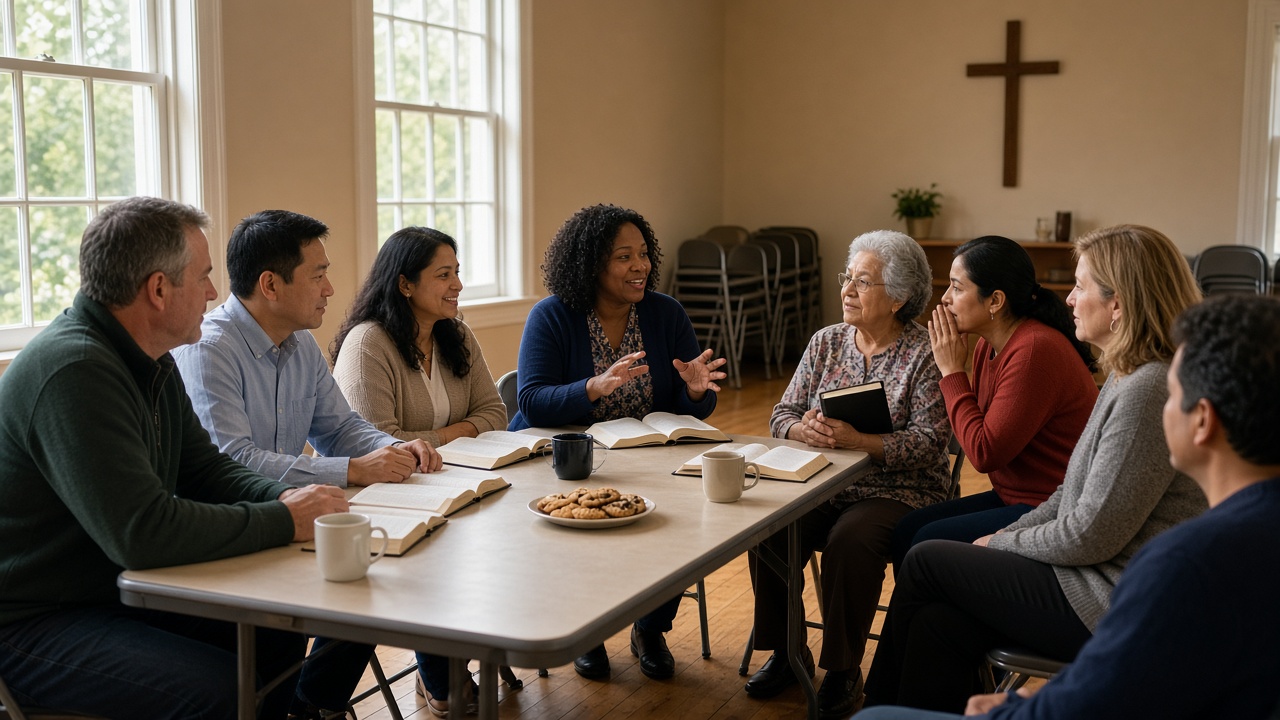
Sunday can succeed and church life still fail
Leaders measure language by the pulpit. If the homily is followable, language is “handled.” That is a reasonable first test. First-time guests who cannot follow the hour rarely come back. It is not the last test.
Church is not only a lecture. Belonging happens in the rooms where people speak back: a small group, a serving-team briefing, a newcomer class, a prayer after the service, the thirty seconds of announcements that tell you what exists besides the sermon. Those rooms are still in the pulpit language in most congregations that have already solved Sunday.
The gap is easy to miss because the people who need another language look fine on Sunday. They were in the room. They heard the Word. Then the map to the rest of the church was spoken once, in English, while they were putting a phone away.
The rooms that stay English after the benediction
Picture an English-speaking suburban church—an example, not a customer story. Spanish audio ran on Sunday. Korean captions ran for a visiting grandmother. The elders report that translation is in place.
Then the week happens.
The small group. One person teaches, then six people talk over each other. The overlay that worked from a pulpit microphone does not automatically work around a coffee urn. If the group never plans for a second language, the member who followed the sermon becomes a guest in the circle that is supposed to be home.
The next-step minute. “Newcomer lunch is in the chapel.” “Women’s Bible study starts Thursday.” “We need two more people on the welcome team.” Those sentences are how a church actually includes someone. If they exist only in the pulpit language, sermon translation produced understanding without a door.
The serving huddle. Ushers, greeters, and kitchen teams get a five-minute briefing before the hour. The bilingual member who needed captions in the pew is often the person you would like on that team. The briefing is English. So is the radio. Language access that stops at sitting down quietly tells them they may receive, not serve.
The class that makes members. Beliefs, baptism, the covenant. Churches that would never preach an untranslated Sunday still run a four-week membership class in one language. The problem is not the software for that night. The problem is earlier: you translated the invitation and not the path.
The hallway conversation. Someone wants to ask what the pastor meant, or whether their child can stay in the gym, or how to get a ride on Thursday. That is not a broadcast. It is one person and another person. If the only plan is a Sunday overlay, the hallway still belongs to whoever already speaks the room.
None of this requires a rude leader. It only requires a language plan that ends when the preacher sits down.
Why churches stop at the pulpit
The sermon is the visible job. It has one speaker, a microphone, a clock, and a budget line people understand. Midweek is many rooms, overlapping voices, and volunteers who did not sign up to be an interpretation department.
Churches also assume that anyone who survived Sunday will “pick up” the rest. That assumption treats church life as extra credit. For the person who thinks in another language, the extra is the only place relationships form. A translated pulpit without a followable Wednesday is how you make spectators.
There is a second, quieter reason. Sunday overlay feels finished. You can point to a QR code and a host. A small group requires the leader to change how people take turns. A serving huddle requires someone to repeat the plan, or to share a phone. That is ministry design, not a plugin. Leaders who already fought to get Sunday approved often do not want a second fight about Thursday.
The fight is the same one. If the public hour is a promise, the rest of the church is where the promise is kept—or quietly withdrawn.
This is a different question from whether translation belongs every Sunday or only on special services. Cadence is whether the pulpit shows up. Scope is whether anything besides the pulpit does.
What actually has to be followable after Sunday
You do not need a second congregation to include people in church life. You need the next rooms to be usable.
They can follow the teaching block in a midweek group. When one person opens the passage, that is still one speaker. Captions or a second voice belong there the same way they belong in the pulpit. Open discussion is harder. Overlapping voices will break a transcript. The group can still decide to take turns, or to pause the overlay and use language pairs for the messy part. The failure is not imperfect captions. The failure is never offering the teaching.
They can catch one next step without a whispered replay. If announcements are in the spoken hour, they should be in the same overlay as the sermon. If the real invitation happens in the lobby, someone has to be able to say it in the guest’s language—or hand them a card that does.
They can sit in the group they were invited to. Splitting a mixed household—teenager in English, parent in the hallway, grandmother at home—is how families leave after the sermon started working. Phones in one circle beat a translated Sunday and an English-only Wednesday.
A hallway question has a tool that is not “find Maria.” One-to-one conversation is a different mode from the sanctuary feed. The bilingual volunteer can greet and pray. They should not be the only way a question gets answered after the blessing.
High-stakes conversations still get a human. Membership interviews, counseling, and legally sensitive meetings are not a caption problem. Do not “fix” midweek by putting a phone between a pastor and a confession.
Where live translation fits—and where it does not
Live translation is the overlay that makes a spoken hour followable when one person is talking. It is not a second church, and it is not a personality.
Hope Translator is built for live transcription and translation of speech—on the web and in the mobile apps—with broadcast (one speaker, many listeners) and solo / conversation (one-to-one) modes. A group leader or greeter can host. People scan a QR code or open a link, pick a language, and read captions, listen to an AI voice, or both. They do not create an account.
Broadcast is the right tool when a small-group leader is teaching, when a newcomer class is presenting, or when the pastor is still on the announcements. The same Sunday session does not magically cover Wednesday. Someone has to start the hour that is actually happening. For a standing Bible study, that workflow is using live translation in small groups. For a newcomer or membership class, see how to set up live translation for a new member class.
Conversation mode is the right tool for the hallway: directions, a prayer request, a question about baptism. That is live conversation translation, not a room-wide feed.
It is the wrong tool when five people talk at once, when the need is a church that shepherds in that language all week, or when the meeting is counseling. Overlapping prayer and a worship playlist will also wreck a phone in the middle of a table. Name those limits in the group, the same way you name them on Sunday.
If you already have a bilingual leader for a stable, one-language circle, that relationship may be the better pastoral answer. Overlay translation is for mixed groups, visiting grandparents, and the member who followed Sunday and still cannot join Thursday.
A midweek test for leaders
Walk last week as a member who can follow the sermon and cannot think in the pulpit language.
- After the blessing, did they know about one group, class, or meal without asking a stranger to repeat it?
- If they came to a small group, could they follow the teaching without a family member giving up their own seat in the conversation?
- Could they serve—or only sit?
- If the usual bilingual volunteer was at a child’s recital, what actually happened on Wednesday?
- Did anyone start translation for the room that was meeting, or only for the room with the pulpit?
If the honest answers are no, Sunday is not the whole problem. Sunday may already be the part you fixed. The remaining wall is church.
Keep the overlay on the sermon. Then treat the next hour people actually join as part of the same promise. Start a session at hopetranslator.com or compare plans on pricing.