What Is Remote Simultaneous Interpretation (RSI)?
The event RFP says “RSI required.” Someone on the production team hears “languages on a phone” and prices an AI overlay. Someone else hears “interpreters” and books a booth that will not fit behind the drape. Both quotes come back, and neither matches what the planner thought they asked for.
Remote simultaneous interpretation is a specific job. The speaker does not pause. A human interpreter renders the meaning a few seconds behind. The interpreter is not in the room. If you only needed another language on a device, you have not yet decided whether you are buying a person or a pipeline.
This is not a setup tutorial. It is the vocabulary you need before you sign a language line item.
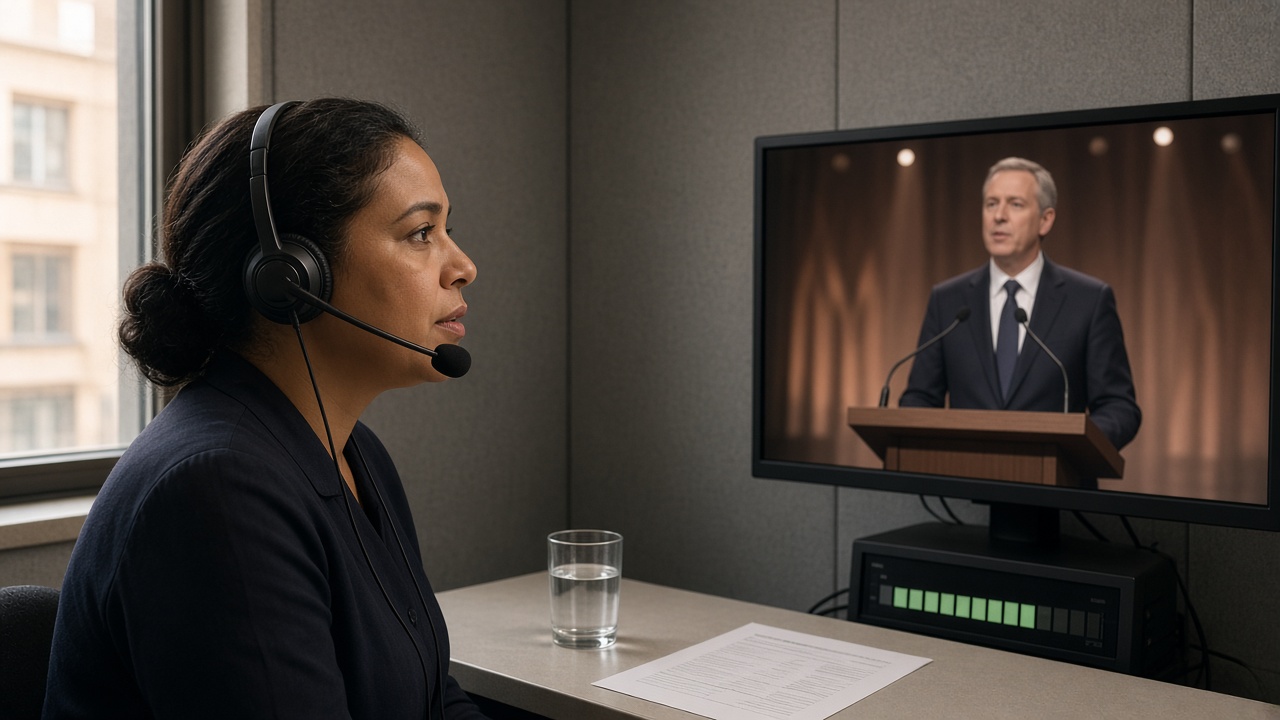
Simultaneous work with a different address
Simultaneous interpretation is the mode. The speaker keeps going. The interpreter holds a short stretch of meaning—the ear–voice span—and speaks in the other language while the original continues. Consecutive interpretation is the other mode: the speaker waits so a second voice can take the room.
Remote is about where that simultaneous work happens. The International Association of Conference Interpreters (AIIC) groups this under distance interpreting: the interpreter is not standing in the same hall as the people who need the other language. In a classic booth, the team sits at the back of the venue, sees the stage, and hears a dedicated floor feed. In RSI, that team sits in an interpreting hub or a prepared workspace somewhere else and receives the event over a platform.
The work in the interpreter’s head does not change. The sound path does. So does what fails when the path is weak.
How the chain actually runs
Every RSI session is a loop with four links.
- Capture. A microphone, a mix-minus, or a meeting platform takes the speaker’s voice. If the sentence never enters that feed, nobody downstream can recover it—human or machine. That is the same rule as a speech-only mixer send.
- Delivery to the interpreter. A simultaneous interpreting delivery platform sends sound and a picture of the speaker to a remote console. ISO 24019:2022 is the standard written for those platforms: faithful sound, synchronized image, a usable interpreter interface, and enough connectivity that the feed does not collapse mid-sentence. The European Commission’s interpreters helped draft it after distance platforms spread through virtual meetings.
- Interpretation. A person listens and speaks. Conference simultaneous work is intense enough that teams usually work in pairs and take turns about every 20 to 30 minutes. RSI does not cancel that staffing. It moves it.
- Delivery to the listener. Attendees pick a language channel on a phone, a browser, a venue receiver, or a meeting-platform audio feed.
To the person in row twelve with earbuds, RSI can look like any other overlay: a code, a language list, a voice a thought behind the stage. The product you purchased is still a human interpreting into that channel. The phone is the receiver. It is not the interpreter. Adding a language in RSI is another interpreter assignment, not a setting.
Why the booth left the building
Distance interpreting existed before 2020. The pandemic is what made RSI ordinary. When rooms closed, specialized delivery platforms—sometimes called RSI platforms—carried the booth over a network. The encyclopedic entry on simultaneous interpreting from the Iberian Association of Translation and Interpreting Studies notes that videoconference interpreting had been used for years, and that COVID-era distancing accelerated those platforms.
Event teams kept using them after travel resumed, for reasons that are logistics rather than fashion.
Booths take floor space and freight. A mid-size ballroom can lose a row of seats to ISO-style booths, or it can skip the furniture and send a clean floor feed off-site.
Interpreters do not have to fly with the speaker. A scientific congress that needs three languages for two days can hire a team that already knows the terminology, instead of paying travel days for every pair.
Hybrid rooms need one language plan that reaches two audiences. People in the hall and people on the livestream can share the same interpreted channel if the platform can deliver it to both.
None of that is a claim that RSI is cheaper in every RFP. Interpreter fees, team size, platform licenses, and technician time still sit on the invoice. What moved is the furniture—and the failure mode. If the venue Wi-Fi drops, an on-site booth still has local audio. A remote team has a black screen.
What RSI is not
The acronym collects unrelated purchases. Separate them in the planning meeting.
It is not consecutive interpretation. If the keynote pauses after every paragraph so a second voice can use the house speakers, you are not doing RSI. You doubled the hour.
It is not whispering. A staffer in the front row murmuring into a guest’s ear is simultaneous work for one person. It does not scale to a breakout, and it is not a platform.
It is not YouTube live captions. Automatic captions on a stream, when they exist, are usually a same-language access feature. They are not a second spoken language. See YouTube live captions vs live translation.
It is not “any app that puts another language on a phone.” Bring-your-own-device listening is how listeners receive the channel. RSI, AI speech translation, and even some FM systems can all end on a phone. The question is who is producing the other language.
Some RSI vendors now sell AI speech translation next to the human service. That is a product menu, not a synonym. Hope Translator vs Interprefy is the branded version of that split: are you hiring interpreters on a remote console, or capturing speech once for a machine overlay?
RSI versus an on-site booth
Both are simultaneous. Both need a clean floor feed. Both hide the second language from people who already follow the stage.
The booth still wins on presence. Interpreters see the room, not only a camera crop. They catch a speaker who turns away from the lectern, a slide that contradicts the sentence, a laugh that means the joke landed. AIIC’s distance-interpreting guidance is blunt about the cost of going remote: visual cues shrink, contextual information drops, and a glitch can hit the interpreters while the hall still sounds fine.
RSI wins on placement. There is no booth to light, no freight for furniture, and the team can sit where the acoustic environment is actually built for the job—a hub with technical staff, or a workspace that meets the same audio expectations. ISO 24019 sits beside older booth and equipment standards; it does not erase them. It describes the platform that replaces the local cable run.
Choose the on-site booth when the event is high-stakes enough that you want the team in the building: a diplomatic session, a medical congress where a mistranslated dosage is unacceptable, a plenary you cannot restart. Choose RSI when the mode is still simultaneous, but the building cannot hold the booths—or the interpreters you need do not live in that city.
A church almost never needs this comparison. Sunday is not a three-language plenary with ISO furniture. The church version of “simultaneous without a booth” is usually a volunteer with an FM pack—a staffing problem, not an RSI platform.
RSI versus AI live translation
This is the comparison most RFPs skip, because both can look identical at check-in.
RSI buys a human simultaneous team per language, connected remotely. Accuracy, tone, and judgment are the interpreter’s. Cost scales with languages, hours, and team size. Last-minute Korean is another booking. The overlay is only as good as the interpreter’s preparation and the feed they hear.
AI live translation captures the speaker once, transcribes the speech, and translates it while the talk continues. Listeners read the other language, hear an AI voice, or both. There is no second human voice to staff per language. Listeners pick from the session. A few seconds of lag is normal; live translation always has a delay, for the same reason simultaneous humans do: meaning is held before it is spoken.
Hope Translator is built for that overlay: live transcription and translation on the web and in the mobile apps, with broadcast (one speaker → many listeners) and solo / conversation (one-to-one) modes. Attendees join with a QR code or link and do not create an account.
Use RSI—or any qualified human team—when a missed nuance is the event: certified interpretation, legal or clinical content, a keynote whose jokes and hedges have to survive. The older comparison still holds: live translation vs a human interpreter is a job decision, not a gadget decision.
Use an AI overlay when the hour you already run should stay the hour you already run, and the people who need another language should not have to wait on a booth quote. Weekly services, mixed-language congregations, mid-size conferences, training days, and rooms that will not know the language mix until the doors open are the usual fit. An overlay does not replace counseling, membership interviews, or any conversation that should never have been added to a caption feed.
Do not buy RSI because the attendee app looks modern, then staff it with a bilingual intern. Do not buy AI because the slide says “simultaneous,” then expect a diplomatic booth. Name the producer of the second language first. The receiver is the easy part.
What still has to be true either way
Remote or on-site, human or overlay, the same three conditions decide whether anyone actually follows.
The speech has to be in the microphone. Walk-away keynotes, floor questions with no handheld, and videos that play only through house speakers never reach the interpreter or the recognizer. Brief the presenters before they need the overlay; that is what to tell speakers when the session is being translated.
Listeners have to find the channel. A language plan that exists only on the run sheet is an English event with a hidden URL. QR cards, a slide that stays up, and one sentence from the emcee are the invitation.
The job has to match the room. Consecutive on the house PA can still be the more dignified choice when almost everyone needs the second language and the schedule can stretch. Simultaneous-style delivery—RSI, a booth, or an overlay—is for the timed hour in a mixed room.
If the RFP said RSI and you needed an overlay, change the RFP. If it said RSI and you needed a booth in the hall, say that too. The expensive mistake is treating three different purchases as one acronym.
Hope Translator will not staff your Spanish pair. It will run the overlay for the hour that should stay on the original clock, in more languages than you will hire this week. Compare current plans on pricing, or start a session at hopetranslator.com and test it on a talk you already give.