How Many Interpreters Does a Conference Actually Need?
The language line on the RFP usually reads like a grocery list. Spanish. French. Maybe Korean if a sponsor asks late. Someone on the planning team hears three names and budgets three people.
The quote that comes back is not three people. For simultaneous work it is a team per language, often doubled again the moment a breakout runs at the same time as the keynote. The gap is not a vendor padding the invoice. It is how professional conference interpreting is actually staffed.
This is not a booking tutorial, and it is not an argument that every session needs a booth. It is the headcount math most RFPs undercount—and the labor market that math sits in. If you are still choosing the mode, start with simultaneous vs consecutive interpretation. The question here is how many humans that mode consumes.
One language is not one person
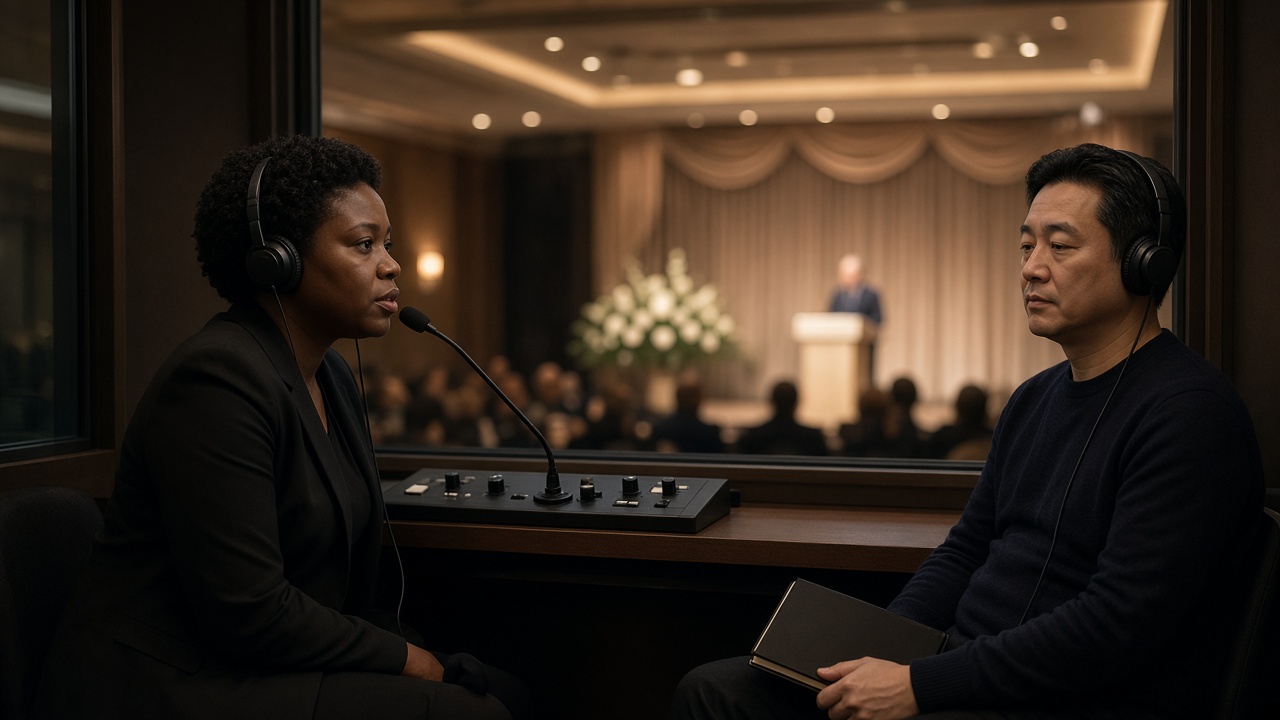
Simultaneous interpretation keeps the speaker moving. A second voice renders the meaning a few seconds behind. That second voice cannot hold a microphone for a three-hour plenary the way a greeter holds a door.
The International Association of Conference Interpreters writes this into its Professional Standards (Article 6, amended 2022). Sustained concentration produces physical and mental fatigue, so team size is a quality rule, not a preference. As a general rule, a simultaneous team is at least two interpreters per language and per booth. A booth working without a break must have two people. An interpreter should not, as a general rule, work alone in the booth without a colleague who can take over.
The U.S. Bureau of Labor Statistics makes the same point in plainer English. In its Occupational Outlook Handbook entry for interpreters and translators, it notes that simultaneous interpreters may work in pairs or small teams for long court or conference assignments because of mental fatigue.
In ordinary conference work the pair shares the microphone in short turns—often about twenty to thirty minutes—so the person who is “off” can still listen, find a term, and step in. The off-mic colleague is not idle. They are the reason the on-mic colleague can keep going.
A 45-minute keynote is not a free pass to book one name. The short-meeting exceptions in the same AIIC article are exactly that: exceptions, for short or general sessions, with quality and health still in view. A regional summit that runs all afternoon is not a short meeting.
Languages and rooms multiply the team
Headcount does not stop at the pair.
AIIC’s same article is blunt about hardware. The number of booths equals the number of target languages, except that a two-language meeting can sometimes share a single booth. English as the floor language plus Spanish, French, and Korean is not “four interpreters.” It is three outbound languages. That is three booths. At two people each, the main room is already six interpreters before anyone asks about Q&A.
Relay—when Korean is taken from the Spanish booth because no one on the roster works directly from English into Korean—adds people, not savings. The standards want at least two interpreters who can provide that relay, and three in a two-way booth that is feeding other cabins.
Then the day leaves the ballroom.
What attendees still miss when only the keynote is translated is not a hospitality essay. It is a staffing map. AIIC’s public FAQ is explicit: the number of interpreters depends on languages, mode, length, and the number of break-out sessions that need interpretation. Two Spanish-language breakouts at 11:00 are two Spanish teams, or Spanish only in one room. There is no version of the math where six people in the plenary booths also cover Room 3B.
Picture a two-day regional summit—an example, not a customer story. The RFP asked for “Spanish and Mandarin.” The planner heard two contractors. Simultaneous staffing for the main stage is four people. A sponsored breakout in Spanish at the same time as a Mandarin roundtable is four more, or a decision that one of those rooms is English-only. Lunch, the expo hall, and the closing town hall never entered the quote. The event is not under-translated because the interpreters were expensive. It is under-translated because the language plan described an event the headcount never matched.
Consecutive interpretation is a different multiplier. AIIC’s minimum for two languages working both ways is still two people, not one bilingual volunteer. Whispered interpretation for one or two listeners still lists at least two interpreters. Churches and small events skip that line constantly. The standard exists because whispering into a noisy room is simultaneous work without a booth, and it burns people out even faster.
The labor market is not waiting in your ballroom
Even a correctly written RFP has to find the people.
The Bureau of Labor Statistics estimated 73,900 interpreter and translator jobs in the United States in 2025. That figure is the whole occupation: spoken interpreting, sign language, and written translation together. It is not 73,900 conference booths sitting idle. Employment is projected to grow about 2 percent from 2025 to 2035—slower than the average for all occupations—with most of the roughly 6,000 openings a year coming from replacements, not from a boom in new seats.
The same handbook lists where those jobs already sit. About 30 percent are in professional, scientific, and technical services. About 28 percent are self-employed. Education takes about 15 percent, hospitals about 7 percent, and government about 5 percent. Schools, clinics, courts, and agencies that must provide language access are already in that mix. A Tuesday church service and a 400-person regional conference are competing for a surplus that the data does not show.
Headline “interpreter shortage” stories are often about American Sign Language, which is a different job from spoken-language interpreting. Mixing those searches is how a team books captions and thinks the Deaf attendees were covered, or books a Spanish booth and thinks accessibility is done. An AI speech overlay does not become sign language because the room is short on ASL interpreters.
None of this is an argument that qualified humans are optional. It is evidence that “we will just hire interpreters” is not a complete plan for every language, every room, and every hour.
What churches copy from this math, badly
Sunday is a timed simultaneous hour with a volunteer roster.
The professional answer for that shape of work is a pair, a clean speech feed, and a way for listeners to hold a channel. The usual church answer is a name: the member who greets in Spanish, whispers from a side chair, and stays after the blessing to explain the newcomer lunch. That design has a documented breaking point in why church volunteer interpreters burn out.
The burnout is not a mystery once you look at the conference numbers. One person is being asked to do what a booth team is not asked to do alone. The service is longer than a “short meeting.” There is no off-mic colleague. The same person is then used as a hallway interpreter, which is a second job.
Churches that cannot staff a pair every Sunday still have a decision. They can treat one language as a human ministry—paid, rotated, and protected—and cover the languages they will not staff with an overlay. They can stop asking a teenager to whisper. They cannot pretend that “Maria can do it” is the same purchase as a conference team.
Remote simultaneous interpretation does not shrink the team. RSI moves the pair off-site. It is still two humans per language, still a speech feed, still a join path for the listener. The phone is the receiver. It is not a reason to book half as many people.
Spend the humans where they change the outcome
The useful question is not “interpreters or software.” It is which hours and which languages are worth a human team, and which hours should stay followable even when that team does not exist.
A qualified pair is the right spend when a missed hedge, dosage, or legal term is the event: a clinical plenary, a diplomatic floor, a contract negotiation, a membership interview, a pastoral conversation that should never have been added to a caption feed. Weigh that choice in live translation vs a human interpreter. The cost of that pair is a headcount times a rate, with minimums and travel.
An overlay is the right spend when the original clock should hold, several languages may walk in, and you will not have a booth for each of them. It is also the right spend for the rooms the booth will not cover: a breakout, an overflow hall, a visiting family on Sunday, the language that appeared on Tuesday morning.
Hope Translator is built for that overlay job: live transcription and translation of speech, on the web and in the mobile apps, with broadcast (one speaker → many listeners) and solo / conversation (one-to-one) modes. Attendees join with a QR code or link, pick a language, and read or listen. They do not create an account. It will not staff your Spanish pair. It will run the languages and the hours you are not going to staff.
How people hear the second language—a rented receiver, a venue keypad, or a phone—is still a separate purchase from how many linguists you hired.
Write the headcount before you write the language list
A language list without a team size is a wish. A team size without rooms is a keynote plan pretending to be a conference.
Count target languages for the room that actually needs them. Count simultaneous pairs, not names. Count parallel sessions that should not fall back to English. Then decide, in writing, which leftover hours are human, overlay, or English on purpose.
If the honest grid is “Spanish pair on the main stage, overlay for everything else,” that is a coherent event. If the grid is “Spanish and Korean” with one contractor and no plan for Room 3B, the quote will look high and the attendees will still be lost.
Ready to cover the languages you will not staff this week? Start a session at hopetranslator.com or compare plans on pricing.