Success Story: Live Translation for a Small Korean Church
In the heart of a diverse community, a small Korean church with approximately 50 adult members discovered how technology could bridge language barriers and create an inclusive worship environment. This is the story of how Hope Translator became an essential part of their weekly services.
The Challenge: Language Barriers in Worship
The journey began when a non-Korean speaking husband of a Korean wife started attending the church. While his wife could understand the Korean sermons, he found himself sitting through services without understanding the message being preached. This language barrier created a significant challenge for the church's mission to welcome all people.
Finding a Solution with Hope Translator
Recognizing the need to make their services accessible to non-Korean speakers, the church leadership decided to try Hope Translator for live sermon translation. The goal was simple: provide real-time translation so that everyone could understand and participate in the worship experience.
Initial Setup Challenges
Technical Decisions
The church faced several practical questions during implementation:
- Screen Sharing vs. Mobile Devices: Should they display the translation on the main screen or have individuals use their mobile devices?
- Audio Setup: How to capture the pastor's voice clearly for accurate translation?
- Display Format: What size and positioning would work best for the congregation?
Finding the Right Approach
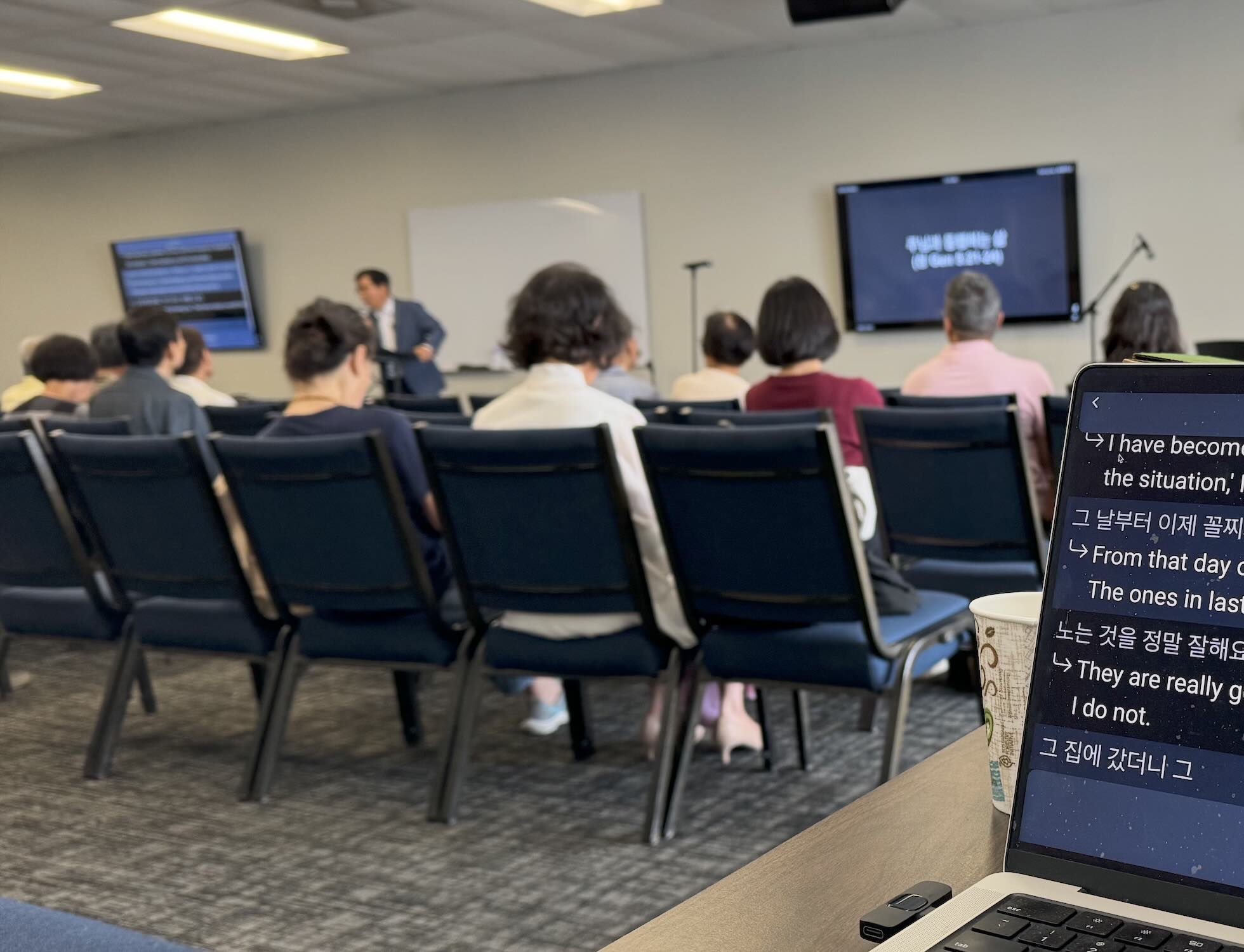
After experimenting with different setups, the church decided to share the live translation on the main screen. This approach proved to be the most effective for their congregation's needs.
Translation Quality and Expectations
While the translation accuracy is not perfect, it's good enough for non-Korean speaking attendees to follow and understand the main points of the sermon. The church found that even with occasional translation errors, attendees could grasp the core message and participate meaningfully in the worship experience. This realistic approach to translation quality helped set appropriate expectations while still providing valuable communication support.
The Transformation: From Experiment to Essential Tool
Early Adoption
Initially, the entire congregation was curious about the new translation feature. Everyone would look at the screen to see how the technology worked. However, as the novelty wore off, only those who needed the translation continued to focus on it, while Korean speakers could concentrate on the pastor.
Growing Impact
The word spread quickly through the community. When other non-Korean speaking people discovered that the church provided live translation, they began to visit. The church now welcomes attendees from various backgrounds:
- Taiwanese families
- Chinese community members
- Russian speakers
- Other international visitors
Flexible Usage Patterns
Multiple Access Methods
The church discovered that different people preferred different ways to access the translation:
- Screen Viewers: Many attendees prefer watching the translation on the main screen
- Mobile App Users: Some individuals use their mobile devices to listen to the translation in real-time
- Hybrid Approach: Others switch between screen and mobile depending on their preference
Weekly Reliability
Hope Translator has become an essential part of their worship service. The church relies on it every week, ensuring that language barriers never prevent anyone from understanding the message.
Key Lessons Learned
Consistency is Key
The most important lesson from this success story is the power of consistency. By providing translation every week, the church has:
- Built trust with non-Korean speaking attendees
- Created a reliable expectation for visitors
- Demonstrated their commitment to inclusion
- Established a sustainable system
Community Growth
The implementation of live translation has led to:
- Increased attendance from diverse backgrounds
- Stronger community bonds
- Enhanced worship experience for all members
- Positive word-of-mouth referrals
As a direct result of this growth, a small English-speaking Bible study group has formed, giving newcomers a welcoming space to ask questions, build relationships, and grow in faith in their first language.
Technical Implementation Tips
Best Practices for Churches
- Audio Quality: Ensure the pastor's microphone is properly positioned for clear speech recognition
- Screen Placement: Position the translation text where it's easily visible but not distracting
- Backup Plans: Have alternative translation methods ready in case of technical issues
- Regular Testing: Test the system before each service to ensure smooth operation
Equipment Recommendations
- High-quality microphone for the pastor
- Reliable internet connection
- Backup power sources
- Clear display screen or projector
The Impact on Church Mission
This small Korean church's story demonstrates how technology can enhance a church's mission to welcome all people. By removing language barriers, they've created an environment where:
- Everyone can participate fully in worship
- Families with mixed language backgrounds can attend together
- The church can reach a broader community
- Cultural diversity is celebrated and accommodated
Looking Forward
The church continues to explore new ways to use Hope Translator:
- Bible Study Groups: Providing translation for small group discussions
- Special Events: Using translation for community outreach events
- Programs: Supporting young people who may not be fluent in Korean
A Model for Other Churches
This success story serves as an inspiration for other churches facing similar challenges. The key takeaways include:
- Start small and build consistency
- Be patient during the learning phase
- Listen to feedback from the congregation
- Adapt the technology to fit your specific needs
- Focus on the mission of inclusion
Ready to Transform Your Church?
If your church is facing language barriers or wants to become more inclusive, Hope Translator can help. Our technology is designed to be:
- Easy to set up and use
- Reliable for weekly services
- Affordable for small congregations
- Flexible for different worship styles
Visit hopetranslator.com to learn how we can help your church break down language barriers and create a more inclusive worship experience.
This success story demonstrates how technology can enhance community and faith, one translation at a time.